- Weekly portions
- Shemot
- Beshalach
בְּשַׁלַּח
Beshalach
the sea, the manna and the path of Israel
- Weekly portion
- 16 of 54
- Verses
- Shemot 13:17–17:16
- Parts
- 12
- Reading time
- 3 h 11 min
- Views
marks places where the translation deliberately departs from the Russian original. Tap it to show the note.
Beshalach is the weekly portion about the path of Israel after the exodus from Egypt. Alex Blend examines the crossing of the sea, the song, the manna, the prayer for sufficiency and the battle with Amalek. The stenogram includes Hebrew, transliteration, translation, the author's commentary and the haftara from the book of Shoftim.
Beshalach: The heroes take a detour
Shemot 13:17–14:8
With God's help we begin reading a new weekly portion of the Torah, the portion Beshalach. It begins with verse 17 of chapter 13 of the book of Shemot, and we continue reading the story of Israel's exodus from Egypt.
וַיְהִי בְּשַׁלַּח פַּרְעֹה אֶת־הָעָם וְלֹא־נָחָם אֱלֹהִים דֶּרֶךְ אֶרֶץ פְּלִשְׁתִּים כִּי קָרוֹב הוּא כִּי אָמַר אֱלֹהִים פֶּן־יִנָּחֵם הָעָם בִּרְאֹתָם מִלְחָמָה וְשָׁבוּ מִצְרָיְמָה׃
vayhí beshallách par'ó et-ha'ám velo-nachám elohím dérech éretz pelishtím ki karóv hu ki amár elohím pen-yinnachém ha'ám bir'otám milchamá veshávu mitzráyma
17 And it was, when Pharaoh drove out the people, God did not direct them through the land of plishtim, because it is a near way. Because the LORD said: “So that the people do not change their mind, seeing war, and would not return to Egypt.”
It is worth paying attention to the verb nachám. The verb lehanchót – to lead, to direct; manché – today this is a host (of a TV program), hanchayá – this is an instruction. And one can translate it as: the Most High did not direct, did not lead them through the land of plishtim (the Philistines). Through the land of plishtim – this means along the coast of the Mediterranean Sea. One could go along the coast of the Mediterranean Sea, where the southern part of the Gaza Strip is now: Rafiach, then Gaza, Ashkelon – and here we are in Israel. This is a well-known, well-trodden trade road. The Egyptian armed forces in their time covered this route, 321 kilometers long, in 10 days. Naturally, the people of Israel would have taken a bit more time. This is a well-equipped trade route with many caravanserais. But, at the same time, there are also many military fortifications on it. So, why did the Most High not lead the people by this route? It is written thus: because it is a near way. The near way is not always the best one.
An interesting word, pen, it does not exist in the Russian language. This word consists of two letters, pei and nun, and it means lest, so that not; pen-yinnachém – so that the people would not change their mind. Here there is a play on words between the word nachám (led them), where the little letter mem at the end is a pronominal ending, and the word yinnachém, which is written exactly the same way and means changed their mind. The LORD led the people by a long way, so that they would not change their mind, seeing war.
What does it mean that the people could see war? As I already said, in this place there were many military fortifications, defensive structures, fortresses. Egypt was a rich country and a tasty morsel for all sorts of robbers, conquerors, aggressors, imperialists. And, accordingly, it built fortifications, spent quite a lot of money on defense. And one could think that the people would be seriously frightened if they passed through this land.
There is also another commentary, rather a historical midrash, and it is connected with events that are hinted at in the first book of Divrei haYamim (7:20–22): “The sons of Efrayim: Shutelach and Bered, and his son Tachat, and his son Elada, and Zavad, his son, and Shutelach, his son. And the inhabitants of Gat, the natives of that land, killed them when they went down to seize their herds. And Efrayim, their father, mourned for them many days, and his brothers came to comfort him.” A very astonishing place. So as not to lose the essence of the text behind the forest of names, I will retell it. The text says that the sons of Efrayim somehow advanced toward Gat, precisely along this sea road, and the local inhabitants killed them on this way. The midrashim, the commentators, the tradition say that the sons of Efrayim – this is a certain part of Israel (Israel as a whole is also called Efrayim), that they miscalculated the end of time and long before the expected exodus from Egypt decided to organize this exodus themselves, came under the military action of the enemy, perished, and their bodies lay there “until now.” Different midrashim say different things about who killed them. Some say that it was the Egyptians (we just said, after all, that there are many military structures there); others say that it was precisely the plishtim who killed them, the natives of Gat. There are also some scholars, believing scholars, who say that the famous Merneptah Stele, which stands right at the Egyptian border, roughly in that place, and on which a victory of the Egyptians over Israel is presumably mentioned, points precisely to these events. I will repeat once more, retell what happened: a certain part of the people of Israel, 30 years before the exodus from Egypt, owing to peculiarities of arithmetic, miscalculated when they had to go out, dashed out of Egypt with all their enthusiasm and perished, and therefore the commentators explain it this way: “Now the people may go, see the bodies of these people, who lie there unburied, will be frightened and, since the way is short, will return to Egypt.”
So, there are two explanations of why the Most High did not lead the people by the short, well-trodden route. The first option – because there are many military defensive structures there, and for slaves who had only just stopped making bricks, this is very frightening. The second – this is the story with the sons of Efrayim, whose corpses perhaps lay there on the road, and whom the people could see. A very mysterious story, about which a great deal has been written; it always happens that way when something is unclear. One way or another, the Most High leads the people by a long way.
וַיַּסֵּב אֱלֹהִים אֶת־הָעָם דֶּרֶךְ הַמִּדְבָּר יַם־סוּף וַחֲמֻשִׁים עָלוּ בְנֵי־יִשְׂרָאֵל מֵאֶרֶץ מִצְרָיִם׃
vayassév elohím et-ha'ám dérech hammidbár yam-súf vachamushím alú vene-yisraél me'éretz mitzráyim
18 And the LORD led (yassév means led around, by a detour) the people through the desert to the Red Sea. The Jews went out, supplied with everything necessary (with full gear), from Egypt.
What has been translated into Russian as the Red Sea (and into English too – Red sea), in Hebrew is called Yam-súf – the Sea of Reeds (suf – reed). Amazingly, this word, suf, can also be read as sof – end, that is, and led them through the sea of the End, led them across the edge of the world.
The word chamushím is a word that is hard to understand. Just look, only two verses, and how many difficult words and concepts there are already here. Some understand the word chamushím as derived from the root chamésh (a fifth part): only a fifth part of the people went out. The midrashim come up with grandiose figures: someone says that only one fiftieth part of the people went out, some “stretch it” and say that only one five-thousandth part went out, and the majority of the people stayed or died as villains, when there was the plague of darkness in Egypt. And since the Jews had light, they could calmly bury all their villains. In general, a great deal has been written around this word chamushím, if one reads and interprets it from chamésh.
Another option is to read the word chamushím as armed, supplied with all the gear, supplied with everything necessary. The word tachmóshet – armament (ammunition), lechamésh – to arm, chamúsh in modern Hebrew also means armed, again from the word chamésh – taken in hand, with a full hand, with a full hand of weapons. And this is the most probable of the understandings. We know, we read about how they begged gifts from the Egyptians.
And Moshe, Moshe – that is a special matter.
וַיִּקַּח מֹשֶׁה אֶת־עַצְמוֹת יוֹסֵף עִמּוֹ כִּי הַשְׁבֵּעַ הִשְׁבִּיעַ אֶת־בְּנֵי יִשְׂרָאֵל לֵאמֹר פָּקֹד יִפְקֹד אֱלֹהִים אֶתְכֶם וְהַעֲלִיתֶם אֶת־עַצְמֹתַי מִזֶּה אִתְּכֶם׃
vayikkách moshé et-atzmót yoséf immó ki hashbéya hishbíya et-bené yisraél lemór pakód yifkód elohím etchém veha'alitém et-atzmotáy mizzé ittechém
19 And Moshe took with him the bones of Yosef, because he had bound the sons of Israel with an oath (Yosef had bound the sons of Israel with an oath), saying: “When God visits you and takes command over you, take my bones from here.”
It is said that while the people were begging jewelry from the Egyptians, Moshe was busy with the bones of Yosef, these are peculiarities of character.
The word mizzé, as we already said, is such a simplified, dismissive attitude toward Egypt, like saying in Russian “outta here”: take my bones outta here.
וַיִּסְעוּ מִסֻּכֹּת וַיַּחֲנוּ בְאֵתָם בִּקְצֵה הַמִּדְבָּר׃
vayis'ú missukkót vayachanú ve'etám biktzé hammidbár
20 And they went out from Sukkot and reached the city of Etam at the edge of the desert.
Some think (we already talked about the word sukkót) that this was a kind of lift from heaven, they were carried over some distance on holy booths, on heavenly booths, and on the second day they set out and reach the city of Etam. Where this city is located, we do not know, there are many different maps. We have no Egyptian materials on this matter, so we cannot really say what city it was. But we can trace in general that they are going toward the present-day Suez Canal through the very middle of the Sinai desert, that is, by the most distant roundabout way.
וַיהוָה הֹלֵךְ לִפְנֵיהֶם יוֹמָם בְּעַמּוּד עָנָן לַנְחֹתָם הַדֶּרֶךְ וְלַיְלָה בְּעַמּוּד אֵשׁ לְהָאִיר לָהֶם לָלֶכֶת יוֹמָם וָלָיְלָה׃
vadonáy holéch lifnehém yomám be'ammúd anán lanchotám haddérech veláyla be'ammúd esh leha'ír lahém laléchet yomám valáyla
21 And the LORD goes before them by day in a pillar of smoke, to lead them, and by night – in a pillar of fire, to give them light, so that they could go by day and by night.
The LORD goes by day in a pillar of smoke, to show them the way. This, besides everything, protects from the sun, and smoke is also visible from afar, very many in the desert use smoke. Here in the Middle East we have no negotiations by means of smoke, no language of smoke, like the Indians. But very often people lit fires with smoke on one mountain to give some signal, to send some sign to another mountain. And since, as we have already noted, smoke is visible from afar, it was easy to see where to go. It was a kind of round-the-clock GPS, a round-the-clock route indicator, which made it possible to walk both by day and by night. And yet another miracle was needed so that the people, not especially fit for long marches, could walk day and night.
לֹא־יָמִישׁ עַמּוּד הֶעָנָן יוֹמָם וְעַמּוּד הָאֵשׁ לָיְלָה לִפְנֵי הָעָם׃
lo-yamishThe Russian transliteration has a small misprint in this word (a consonant y where the vowel i belongs). The English line follows the Hebrew: yamish. ammud he'anan yomam ve'ammud ha'esh layla lifne ha'am
22 The pillar of smoke by day and the pillar of fire by night did not depart from the people.
We see a miracle, that the people go out, another miracle, that the people went by a long road, that the people walk day and night. With this chapter 13 ends, and we begin reading chapter 14, as if “and meanwhile...”: what is happening behind the scenes, what is happening there in Egypt?
וַיְדַבֵּר יְהוָֹה אֶל־מֹשֶׁה לֵּאמֹר׃
vaydabbér adonáy el-moshé lemór
1 And the LORD spoke to Moshe, saying:
דַּבֵּר אֶל־בְּנֵי יִשְׂרָאֵל וְיָשֻׁבוּ וְיַחֲנוּ לִפְנֵי פִּי הַחִירֹת בֵּין מִגְדֹּל וּבֵין הַיָּם לִפְנֵי בַּעַל צְפֹן נִכְחוֹ תַחֲנוּ עַל־הַיָּם׃
dabbér el-bené yisraél veyashúvu veyachanú lifné pi hachirót ben migdól uvén hayám lifné bá'al tzefón nichchó tachanú al-hayám
2 “Speak to the sons of Israel: and they will rise, and they will approach, and they will stop near the place that is called Pi-haChirot, between Migdol and the sea, before Ba'al-Tzefon; stop and calm down on the shore of the Red Sea (set up a camp and a rest for yourselves).”
Pi-haChirot – this is, literally, the mouth of freedom in Hebrew. Again, we do not know an Egyptian place with such a name, but we know that roughly there, along the route, there is a place that is called Pi-Tchor. Another pronunciation of the name of this place is also possible, but the point is that this is the mouth of a certain Egyptian deity by the name of Hathor. It was believed that this place was enchanted and that those who come up to it, they cannot go any further. This was a special kind of Egyptian sorcery for runaway slaves. Perhaps the Egyptians themselves believed in it, or perhaps they instilled it in the slaves. Beyond this “mouth,” beyond two cliffs standing next to each other at the end of a gorge, – freedom, a way out, but no one could pass them, and, according to legend, according to tradition, the people would begin to wander about the desert. And the Most High does not tell them to go out beyond this place, but on the contrary, says: “Stop here.”
Bá'al Tzefón – this is the northeastern part of the Nile delta, the northernmost point of the Nile.
וְאָמַר פַּרְעֹה לִבְנֵי יִשְׂרָאֵל נְבֻכִים הֵם בָּאָרֶץ סָגַר עֲלֵיהֶם הַמִּדְבָּר׃
ve'amár par'ó livné yisraél nevuchím hem ba'áretz sagár alehém hammidbár
3 And Pharaoh said to the sons of Israel: “They have gotten tangled in that land, they have lost their way, the desert has shut them in.”
Where did Pharaoh come from here, and how does he speak with the sons of Israel? He doesn't! It is the Most High retelling to Moshe what is happening there, in faraway Ramses, in the faraway Egyptian capital. In the faraway capital Pharaoh speaks, as it were, with the people of Israel: “They have gotten tangled in that land, they have lost their way, because everything there is enchanted, they will walk there in circles, the desert has shut them in, the desert has swallowed them, has lured them away with delusions, with mirages, and so they will wander there. How convenient for me! Well, and one more piece of evidence that maybe that God of theirs is a God worth nothing at all!” Why could Pharaoh even think such a thing after everything that had happened to him? The Most High continues and says:
וְחִזַּקְתִּי אֶת־לֵב־פַּרְעֹה וְרָדַף אַחֲרֵיהֶם וְאִכָּבְדָה בְּפַרְעֹה וּבְכָל־חֵילוֹ וְיָדְעוּ מִצְרַיִם כִּי־אֲנִי יְהוָה וַיַּעֲשׂוּ־כֵן׃
vechizzaktí et-lev-par'ó veradáf acharehém ve'ikkavedá befar'ó uvchol-cheló veyade'ú mitzráyim ki-aní adonáy vaya'asu-chén
4 “And I strengthened the heart of Pharaoh, and he will pursue you, and I will be glorified over Pharaoh and over all his host. And the Egyptians will know that I am the LORD!” And they did so.
Since some doubt still remained in Pharaoh, still smoldered in him, the Most High gave him the freedom to fan this doubt into flame: perhaps the Egyptian sorcery worked after all, you see where they stopped? They will not break free from me!
The word ve'ikkavedá can be translated as and I will make heavy, and I will strike heavily, but it can also be translated as when I am glorified, I will bring glory to Myself over Pharaoh and over all his host.
And they did so – it is not the Egyptians who did so, but the Jews did so and encamped as the Most High had commanded them.
וַיֻּגַּד לְמֶלֶךְ מִצְרַיִם כִּי בָרַח הָעָם וַיֵּהָפֵךְ לְבַב פַּרְעֹה וַעֲבָדָיו אֶל־הָעָם וַיֹּאמְרוּ מַה־זֹּאת עָשִׂינוּ כִּי־שִׁלַּחְנוּ אֶת־יִשְׂרָאֵל מֵעָבְדֵנוּ׃
vayuggád lemélech mitzráyim ki varách ha'ám vayehaféch leváv par'ó va'avadáv el-ha'ám vayomerú ma-zót asínu ki-shilláchnu et-yisraél me'ovdénu
5 And it was reported to the king of Egypt that the people had fled, and the heart of Pharaoh and of his servants turned over. And they said: “What have we done, that we let Israel go from our slavery?”
The word lehehaféch means to turn over, héfech means the opposite, mahpechá – an overturn, a revolution. A revolution took place inside Pharaoh's heart. They understood that the people, on the one hand, had not gone away for three days; on the other hand, the people do not seem to be going to bless Pharaoh in any way, as he had asked, to pray for him in any way. After all, perhaps Pharaoh had hoped that part of this blessing would be that the Jews would pray and the firstborn would come back to life (well, at any rate, his firstborn would come back to life), after all, for this very purpose he had issued diplomatic passports, and now the people are running away. But the sorcery is working, and besides, the Egyptians had already come to miss the Jews, whom one could blame for all troubles.
The people understood that they had been fooled. The people did not understand or forgot that there is an action of the Most High here. The Most High gave man the freedom to hold on to his doubts. In exactly the same way, by the way, this will happen later with the Jews too, who saw miracles in the desert, saw everything that was happening there, but they grumbled, because the Most High gave them the freedom to grumble; despite the miracles there was grumbling. At the same time the Most High helped them, educated them, taught them to subdue this grumbling. Here, with Pharaoh, it is a little different. Pharaoh, in fact, has much more freedom of will, and his doubts are easily inflated to global proportions, and he already understands, he thinks that it was a fatal mistake – to let go such a quantity of labor force, and that the God before Whom they bowed, to Whom they submitted, is not so strong after all, since the Jews cannot get out of the magic Egyptian mousetrap. Pharaoh acts very emotionally:
וַיֶּאְסֹר אֶת־רִכְבּוֹ וְאֶת־עַמּוֹ לָקַח עִמּוֹ׃
vaye'sór et-richbó ve'et-ammó lakách immó
6 Pharaoh himself (with his own hands) harnessed his chariot, and took his people with him.
We already mentioned, when we spoke about Yosef, that love breaks subordination, in exactly the same way hatred also breaks subordination. When a person is driven by some emotions, he no longer says: “This is not for someone of my rank to do, I will ask the servants,” no, he wants to pour out his anger himself into some action, and Pharaoh stoops so low that he harnesses the chariot himself.
וַיִּקַּח שֵׁשׁ־מֵאוֹת רֶכֶב בָּחוּר וְכֹל רֶכֶב מִצְרָיִם וְשָׁלִשִׁם עַל־כֻּלּוֹ׃
vayikkách shesh-me'ót réchev bachúr vechól réchev mitzráyim veshalishím al-kulló
7 And he took six hundred chosen chariots, and he took all the chariots of Egypt (all the Egyptian transport), and commanders over all of them.
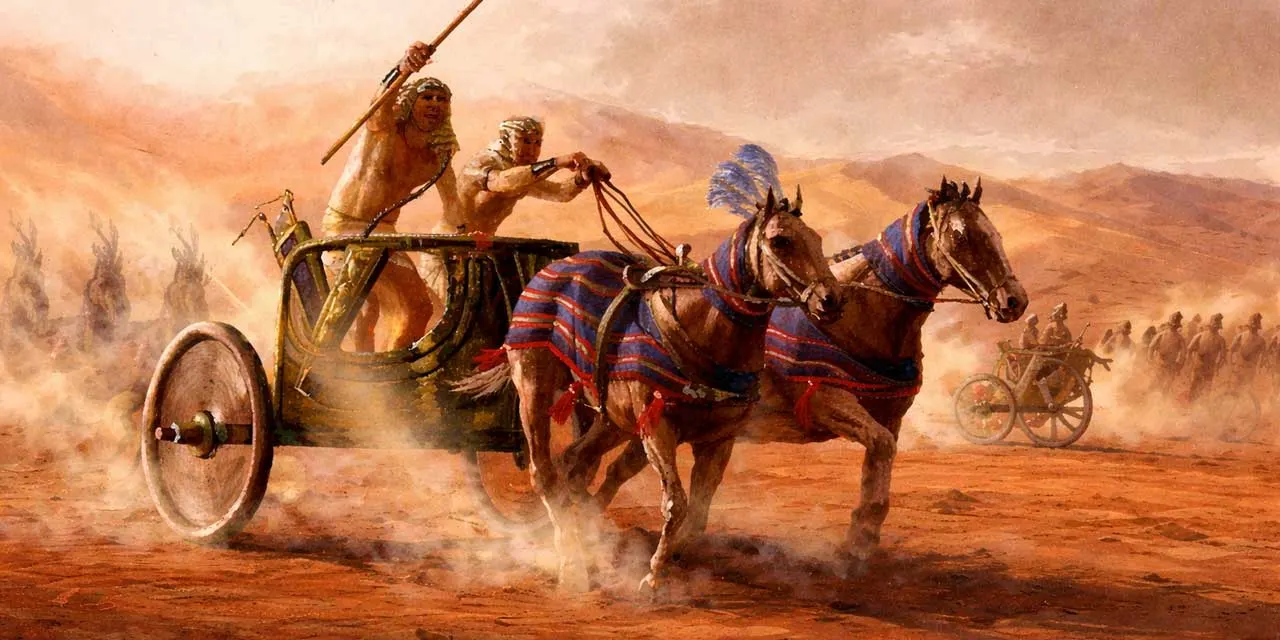
When we spoke (12:37) about the 600 thousand men on foot who went out of Egypt, we mentioned that a combat unit can be counted by the number 600, it can mean an army, a strong army, and here we see a confirmation of this: 600 chosen chariots – this is the Egyptian chariot “special forces,” which Pharaoh takes with him. But, besides that, he also announces a full mobilization, that is, all the Egyptian transport, all the Egyptian cavalry and tank units – everything that Egypt had in its arsenal, and that was quite a lot. As I already said, Egypt had to protect itself somehow, and its army had to be large and well trained. It has a great deal of military know-how, it has fast chariots that move very quickly and that others do not have, many teams of horses, and in general, Egypt is well armed. All this Pharaoh gathers in a hurry, takes with him.
וַיְחַזֵּק יְהוָֹה אֶת־לֵב פַּרְעֹה מֶלֶךְ מִצְרַיִם וַיִּרְדֹּף אַחֲרֵי בְּנֵי יִשְׂרָאֵל וּבְנֵי יִשְׂרָאֵל יֹצְאִים בְּיָד רָמָה׃
vaychazzék adonáy et-lév par'ó mélech mitzráyim vayirdóf acharé bené yisraél uvné yisraél yotze'ím beyád ramá
8 And the LORD strengthened the heart of Pharaoh, king of Egypt, and he began to pursue the sons of Israel, and the sons of Israel are going out with a strong hand.
All this expressiveness that is described here, all this haste that is going on in Egypt, when Pharaoh harnesses himself, and mobilizes everyone, and gathers everyone – all of this shatters against the last phrase of verse 8: “And the sons of Israel are going out with a strong hand.” They go with all their capacity – on the one hand, they walk day and night, on the other hand, they walk without hurrying, they walk as in the song: “a man walks by like a master.” They go at their own free, good speed, fearing no one, as if on their own land. A strong people goes out, with a strong hand, against the background of all this Egyptian commotion.
We looked death in the face
Shemot 14:9–14
We talked about how, by the command of the Most High, the people of Israel, who had come out of Egypt, encamped at the place called Pi-haChirot, on the very shore, at the approach to the Red Sea. The Most High also told Moshe what was going on in Egypt, and also that Pharaoh harnessed the chariot with his own hands, contrary to all the rules of Egyptian subordination, and is moving at the head of the army in pursuit of the Israelites, counting on the fact that they had gotten lost in the desert because of the strong Egyptian sorcery and could in no way get out. Right here the Egyptian ideology, the Egyptian faith could triumph, and, actually, the power and personal authority of Pharaoh could be strengthened.
So, we continue with verse 9 of chapter 14.
וַיִּרְדְּפוּ מִצְרַיִם אַחֲרֵיהֶם וַיַּשִּׂיגוּ אוֹתָם חֹנִים עַל־הַיָּם כָּל־סוּס רֶכֶב פַּרְעֹה וּפָרָשָׁיו וְחֵילוֹ עַל־פִּי הַחִירֹת לִפְנֵי בַּעַל צְפֹן׃
vayirdefú mitzráyim acharehém vayassígu otám choním al-hayám kol-sús réchev par'ó ufarasháv vecheló al-pí hachirót lifné ba'ál tzefón
9 And Egypt pursued them (we will still come back to this expression), and they overtook them when they were encamped at the sea – all the cavalry horses of Pharaoh, and his horsemen, and his army, they all overtook them at the place called Pi-haChirot, before Ba'al-Tzefon.
וּפַרְעֹה הִקְרִיב וַיִּשְׂאוּ בְנֵי־יִשְׂרָאֵל אֶת־עֵינֵיהֶם וְהִנֵּה מִצְרַיִם נֹסֵעַ אַחֲרֵיהֶם וַיִּירְאוּ מְאֹד וַיִּצְעֲקוּ בְנֵי־יִשְׂרָאֵל אֶל־יְהוָה׃
ufar'o hikriv vayis'u vene-yisrael et-enehem vehinne mitzrayim nose'a acharehem vayireu me'od vayitz'aku vene-yisrael el-adonay
10 And Pharaoh brought near, and the sons of Israel raised their eyes, and behold – Egypt. And the sons of Israel were afraid, and the sons of Israel cried out to the LORD.
One could have written Pharaoh came near, but here it is about Pharaoh coming near and thereby inspiring his army to come near, to attack Israel. Pharaoh moves at the head of this army. Here, as we also read in the previous verse, it is written Egypt, it is not written the Egyptians, it is not written the Egyptian army, but – Egypt. This is what the Jews saw with their own eyes: a huge empire, it seemed to them, is moving after them. A huge black field of warriors of the Egyptian army, the army of the most powerful empire in the region, and indeed at that time the region was just one. The Jews, the sons of Israel, are in a difficult position. Behind them – the salt sea, which will not even give proper water, all around – desert, not a bush, not a pebble behind which one could hide with a musket (though, what muskets, muskets had not been invented yet). No possibility to hold a defense, to hide the children and women at least somewhere – there is nothing. Against them stands a huge army, the desert, the heat, and nowhere to run. It is frightening. They raised their eyes, and behold: Egypt.
In the text of the Torah, after the word mitzráim, Egypt, there is a vertical line, this means – a theatrical pause: and behold, Egypt is riding after them, chasing them. This is a very frightening picture. Before this we read about various situations that happened to the forefathers, how Avraham, Yitzchak, Yaakov acted, how they behaved in difficult circumstances. Now for the first time we read how the people will act in a difficult situation.
The Talmud says that the people split into four parts: into the despairing, who said: “Let us throw ourselves into the sea!”; into those who said: “Let us surrender, give ourselves up to the Egyptians, let us return to Egypt!”; into the violent ones, let us put it that way, who said: “Let us clash, let us fight!”; into the God-fearing, who said: “Let us ask for help from outside!” And outside, glory to God, we have only the Most High. The people are diverse, they consist of different people, and different people behave in different ways.
And the sons of Israel were afraid, and the sons of Israel cried out to the LORD. Those who were frightened could react either like those who wanted to surrender (the panic-mongers), or like those who cried out to the Most High. We read further about one more kind of reaction to fear:
וַיֹּאמְרוּ אֶל־מֹשֶׁה הַמִבְּלִי אֵין־קְבָרִים בְּמִצְרַיִם לְקַחְתָּנוּ לָמוּת בַּמִּדְבָּר מַה־זֹּאת עָשִׂיתָ לָּנוּ לְהוֹצִיאָנוּ מִמִּצְרָיִם׃
vayomerú el-moshé hamibbelí en-kevarím bemitzráyim lekachtánu lamút bammidbár ma-zót asíta lánu lehotziánu mimmitzráyim
11 And they said to Moshe: “Is it for lack of graves in Egypt that you took us to die in the desert? What have You done to us, bringing us out of Egypt?
הֲלֹא־זֶה הַדָּבָר אֲשֶׁר דִּבַּרְנוּ אֵלֶיךָ בְמִצְרַיִם לֵאמֹר חֲדַל מִמֶּנּוּ וְנַעַבְדָה אֶת־מִצְרָיִם כִּי טוֹב לָנוּ עֲבֹד אֶת־מִצְרַיִם מִמֻּתֵנוּ בַּמִּדְבָּר׃
halo-zé haddavár ashér dibbárnu elécha vemitzráyim lemór chadál mimménu vena'avdá et-mitzráyim ki tov lánu avód et-mitzráyim mimmuténu bammidbár
12 Why, this is the very word that we spoke to you in Egypt, saying: ‘Leave us alone, and we will serve Egypt, because it is better for us to be slaves in Egypt than to die in the desert!’
The third kind of reaction that we see here is a reaction of the type: I told you so, we told you so! There is no way out of the situation here, in this case they propose nothing, but at least they console themselves: “We told you so! If we die, then at least we will find someone else to blame for it, and the someone else to blame is Moshe.” This is a matter of searching for the guilty one.
When we see such different reactions, we can identify ourselves with one group or another and say: “These here are good, and those are bad.” It is easy to say this when we sit in a heated room or a room with air conditioning and have the possibility to analyze how we ourselves would have acted at such a moment. What switches on in us when behind us is the sea, ahead of us is Egypt? Panic (to throw ourselves into the sea)? The desire to surrender (and return to Egypt)? Aggression (the desire to fight)? Or, after all, faith (to cry out to the Most High)?
So, all the options have been listed, but we will see later that the Most High wants to teach something else.
וַיֹּאמֶר מֹשֶׁה אֶל־הָעָם אַל־תִּירָאוּ הִתְיַצְבוּ וּרְאוּ אֶת־יְשׁוּעַת יְהוָה אֲשֶׁר־יַעֲשֶׂה לָכֶם הַיּוֹם כִּי אֲשֶׁר רְאִיתֶם אֶת־מִצְרַיִם הַיּוֹם לֹא תֹסִיפוּ לִרְאֹתָם עוֹד עַד־עוֹלָם׃
vayomer moshé el-ha'ám al-tiráu hit'yatzevú ur'ú et-yeshu'át adonáy asher-ya'asé lachém hayom ki ashér re'itém et-mitzráyim hayom lo tosífu lir'otám od ad-olám
13 And Moshe said to the people: “Do not be afraid, stand up and you will see the deliverance of the LORD, which He has worked for you today! For the way you see Egypt today, never again in history will you see them.
That is, you will never again see such strength in Egypt, and at the same time you will never again look at Egypt with such fearful eyes. The Most High will work salvation for you and will deliver you not only from Egypt, but also from the fear of Egypt as of the army of a huge empire.
יְהוָה יִלָּחֵם לָכֶם וְאַתֶּם תַּחֲרִישׁוּן׃
adonáy yillachém lachém ve'attém tacharishún
14 The LORD will fight for you, and you – be silent here (calm down or, perhaps, a sterner shout)!”
Moshe says: “Do not meddle in this matter. Calm down, be silent inside and be silent outside, as if you had gone deaf. Stop being afraid, stop warily listening to this reality. Enjoy the spectacle, watch how the Most High will work deliverance. Do your work calmly, humbly, pay no attention to Egypt, forget about its existence for now. This war will be waged by the Most High!”
Sea cavalry
Shemot 14:15–31
So, the Egyptians have caught up with the Israelites, the people of Israel behave in different ways. Moshe calms everyone and promises that the Most High will wage war for them, and says: “Be calm!” This does not mean that one can stock up on popcorn and watch the battle. It means to act calmly, in a coordinated way and without panic.
וַיֹּאמֶר יְהוָה אֶל־מֹשֶׁה מַה־תִּצְעַק אֵלָי דַּבֵּר אֶל־בְּנֵי־יִשְׂרָאֵל וְיִסָּעוּ׃
vayomer adonáy el-moshé ma-titz'ák eláy dabbér el-bene-yisraél veyissáu
15 And the LORD said to Moshe: “Why do you cry out to Me? Speak to the sons of Israel, and let them move!
These are astonishing words, because we did not read that Moshe was crying out here or appealing to the Most High. Some commentators say: “Well then, since God answered him this way, from this we can understand that Moshe too was among those who cried out to the Most High.” One can understand it that way. Other commentators, however, say that the Most High addresses Moshe partly as the people of Israel. He does not address the whole people, He says to Israel through Moshe: “What are you shouting for? Why do you cry out to Me?” But it is still unclear: what is bad about calling out to the Most High in a time of calamity? And the commentators say that the people had everything necessary simply to act, there was no reason to be frightened and to feel that they were in calamity, because the Most High had promised His protection, had promised that the people would arrive in the Promised Land, would arrive in safety. One could (and one should) only turn to the Most High, let us say, for instructions.
The last verb, linsóa, means to set off, to get going, to begin moving. We know that the people of Israel are pressed against the sea and seemingly have nowhere to move. The Most High continues to instruct Moshe and says to him:
וְאַתָּה הָרֵם אֶת־מַטְּךָ וּנְטֵה אֶת־יָדְךָ עַל־הַיָּם וּבְקָעֵהוּ וְיָבֹאוּ בְנֵי־יִשְׂרָאֵל בְּתוֹךְ הַיָּם בַּיַּבָּשָׁה׃
ve'attá harém et-mattechá unté et-yadechá al-hayám uvka'éhu veyavóu vene-yisraél betóch hayám bayabbashá
16 And you, raise your staff and direct your hand at the sea, and the sea will be split – and the sons of Israel will go inside the sea, as on dry land.
The whole people of Israel went out with all the necessary gear. We have already said that they have everything that is needed: stop anyone, ask for a size 14 wrench, he will rummage in his bag and give it to you. Moshe also has everything necessary: he has a staff. Therefore, in part, the Most High says: “Why do you call out to Me? You have a staff. You can direct your hand at the sea, and the sea will be split, will divide in two.”
וַאֲנִי הִנְנִי מְחַזֵּק אֶת־לֵב מִצְרַיִם וְיָבֹאוּ אַחֲרֵיהֶם וְאִכָּבְדָה בְּפַרְעֹה וּבְכָל־חֵילוֹ בְּרִכְבּוֹ וּבְפָרָשָׁיו׃
va'aní hinení mechazzék et-lév mitzráyim veyavóu acharehém ve'ikkavedá befar'ó uvchol-cheló berichbó uvfarasháv
17 And I will strengthen, make firm the hearts of the Egyptians, and they will go after them (the Egyptians after the people of Israel), and I will put all My weight on Pharaoh, on his army and on his horsemen.
The words of the Most High: “I will put all My weight on Pharaoh” can also be translated this way: “I will be glorified in Pharaoh, his army and horsemen.” If we accept the first option, translate the word kavéd as weight and remember that in physics force is the product of mass and acceleration, then we can understand that the Most High will give the Egyptians mass, will add weight to them, so that they would feel beautiful, strong, so that they would move at great speed. The Most High will strengthen the Egyptians in every possible way, will give them the opportunity to feel strong. Often we want to do something in the name of the Most High or, God forbid – the opposite, no, and fear hinders us, fear troubles us, and we pray to the Most High that he remove these fears from us. Here the Most High shows “mercy” to the villainy of Pharaoh and gives him the strength to carry out his desires, not to fear the Creator. The Most High says: “I will give strength to Pharaoh, to all his host, and to his chariots, and to his horsemen.”
וְיָדְעוּ מִצְרַיִם כִּי־אֲנִי יְהוָה בְּהִכָּבְדִי בְּפַרְעֹה בְּרִכְבּוֹ וּבְפָרָשָׁיו׃
veyade'ú mitzráyim ki-aní adonáy behikkavedí befar'ó berichbó uvfarasháv
18 And they will know that I am the LORD, when I strengthen them (or am glorified in them).”
וַיִּסַּע מַלְאַךְ הָאֱלֹהִים הַהֹלֵךְ לִפְנֵי מַחֲנֵה יִשְׂרָאֵל וַיֵּלֶךְ מֵאַחֲרֵיהֶם וַיִּסַּע עַמּוּד הֶעָנָן מִפְּנֵיהֶם וַיַּעֲמֹד מֵאַחֲרֵיהֶם׃
vayissá mal'ách ha'elohím haholéch lifné machané yisraél vayélech me'acharehém vayissá ammúd he'anán mippenehém vaya'amód me'acharehém
19 And the Angel of God set out, who was going before the camp of Israel, and went in the midst of them, the pillar of cloud moved ahead of them and stood behind them.
Usually in all the texts we read malách adonáy, malách with the name of the Most High. Malách elohím – this is a rare case when God's presence on earth is described this way. In this case God, as we know, goes with a pillar of smoke and a pillar of fire, goes before the people, and here something unusual happens: the Divine presence turns toward the sea with fire, toward the Egyptians with fog, and there comes such a sharp division into light and darkness. The Egyptians find themselves wrapped in gloom, Israel has an illuminated sea. And this indicates that one must move.
So, these are two images of the presence of the Most High.
וַיָּבֹא בֵּין מַחֲנֵה מִצְרַיִם וּבֵין מַחֲנֵה יִשְׂרָאֵל וַיְהִי הֶעָנָן וְהַחֹשֶׁךְ וַיָּאֶר אֶת־הַלָּיְלָה וְלֹא־קָרַב זֶה אֶל־זֶה כָּל־הַלָּיְלָה׃
vayavó ben machané mitzráyim uvén machané yisraél vayhí he'anán vehachóshech vayá'er et-halláyla velo-karáv ze el-zé kol-halláyla
20 And it stood between the camp of the Egyptians and the camp of Israel, and there was a cloud of darkness, and the night was lit up. And they did not come near each other all night.
Such a complete division into light and darkness between Israel and Egypt for the whole night.
וַיֵּט מֹשֶׁה אֶת־יָדוֹ עַל־הַיָּם וַיּוֹלֶךְ יְהוָה אֶת־הַיָּם בְּרוּחַ קָדִים עַזָּה כָּל־הַלַּיְלָה וַיָּשֶׂם אֶת־הַיָּם לֶחָרָבָה וַיִּבָּקְעוּ הַמָּיִם׃
vayét moshé et-yadó al-hayám vayolech adonáy et-hayám berúach kadím azzá kol-halláyla vayásem et-hayám lecharavá vayibbake'ú hammayim
21 And Moshe stretched out his hand over the sea, and the Most High led (as if by the hand) the sea with a strong east wind all night (as if forcing a way through the sea, pushing it apart with hands). And made the sea like ruins, and the water parted.
That is, a passage formed in the sea, dry land was laid bare, and now the Jews, the people of Israel, will go, stepping on dry land on which no one except them, neither before nor after, will ever step. Each one will have some strip of dry land of his own, on which, out of all humanity, only he has stepped.
וַיָּבֹאוּ בְנֵי־יִשְׂרָאֵל בְּתוֹךְ הַיָּם בַּיַּבָּשָׁה וְהַמַּיִם לָהֶם חוֹמָה מִימִינָם וּמִשְּׂמֹאלָם׃
vayavó'u vene-yisraél betóch hayám bayabbashá vehammáyim lahém chomá miminám umissemolám
22 And the sons of Israel went through the sea on dry land, and the water stands like a wall to the right and to the left of them.
It is rather frightening – to walk through the sea in this way. The Most High made the sea part by the wind. This, of course, puzzles many researchers, who want, who try somehow to make the matter easier for the Most High, and they say: “Most likely, this did not take place on the big Red Sea, but in a lake region. There, in the Nile delta, there were several lakes connected with one another, which the Egyptians used for land reclamation, for connecting the Nile with the sea, for shipping, and there are even papyri that call this place Suf.” More than that, the ancient Egyptian Papyrus Anastasi says that this place is also called Suf in Hebrew. And one can suppose that precisely there – not in the sea, but in this shallow, almost children's pool – the miracle took place, and there the Jews crossed the sea. This, as I already said, is of course an attempt to make the work and service easier for the Most High. Maybe that is how it was. We have no exact evidence, no map, no photographs. The sons of Israel did not have Instagram, did not post selfies there, so that we could see today where they passed. And one can search for this place from the point of view of archaeology, from the point of view of history, but to choose it from the point of view of which miracle the Most High is capable of and which – not, I think, is an unreasonable approach.
וַיִּרְדְּפוּ מִצְרַיִם וַיָּבֹאוּ אַחֲרֵיהֶם כֹּל סוּס פַּרְעֹה רִכְבּוֹ וּפָרָשָׁיו אֶל־תּוֹךְ הַיָּם׃
vayirdefú mitzráyim vayavó'u acharehém kol sus par'ó richbó ufarasháv el-tóch hayám
23 And Egypt pursued them, and they went after them, every horse of Pharaoh, all his chariots and his horsemen, all went into the sea.
There comes a certain moment when everyone is in the sea: the people of Israel and the Egyptians. Naturally, the people of Israel come out onto the other shore first, and in verse 24 we read what begins to happen in the morning:
וַיְהִי בְּאַשְׁמֹרֶת הַבֹּקֶר וַיַּשְׁקֵף יְהוָה אֶל־מַחֲנֵה מִצְרַיִם בְּעַמּוּד אֵשׁ וְעָנָן וַיָּהָם אֵת מַחֲנֵה מִצְרָיִם׃
vayhí be'ashmóret habbóker vayashkéf adonáy el-machané mitzráyim be'ammúd esh ve'anán vayáhom et machané mitzráyim
24 And it was in the morning shift, and the Most High looked down on the camp of the Egyptians from both pillars, and wrapped the camp of the Egyptians in confusion.
The Torah often uses a language, one could say, a temple language, which is used in any temple, including in the temple of the people of Israel. Shifts and watches were used practically everywhere, both in temples and in palaces. The night was divided into three equal parts, and three changes of the guard took place during the night. With the morning watch the evening shift ends, the last night shift ends, and it is time to hand the guard over to the morning command, the time of the morning changeover, that is, the very, very break of dawn.
The word lehashkíf always means to look from above. We already read (12:7) about the word mashkóf (lintel) – this is what is located at the top, the upper crossbeam; from the same root – to look down, to view from above; from the same root the word mishkafáyim, glasses in modern Hebrew, and the word hashkafá – worldview, that is, to see generally, to see as a whole.
Many say that fire and smoke mixed above the Egyptian people. The dry land became muddy, the horses began to sink up to the stirrups in this dry land, the Egyptians fell into confusion. We can say that Pharaoh rushed into the sea at enormous speed, feeling as if he were in an “SUV” with loud music, and pressed the gas with all his strength, with the encouragement of the Most High. The Most High Himself, as it were, pressed the gas pedal for him, adding strength to him. And suddenly, without releasing the gas pedal, in complete darkness, Pharaoh also hit the brake. And, naturally, a small technical breakdown occurred.
וַיָּסַר אֵת אֹפַן מַרְכְּבֹתָיו וַיְנַהֲגֵהוּ בִּכְבֵדֻת וַיֹּאמֶר מִצְרַיִם אָנוּסָה מִפְּנֵי יִשְׂרָאֵל כִּי יְהוָה נִלְחָם לָהֶם בְּמִצְרָיִם׃
vayásar et ofán markevotáv vaynahagéhu bichvedút vayomer mitzráyim anúsa mippené yisraél ki adonáy nilchám lahém bemitzráyim
25 And the wheels flew off his chariots, and he was carried along heavily, and the people of Egypt say: “We had better retreat, let us flee from Israel, because the LORD fights on their side against Egypt!”
That is, the wheels came off, bounced off the chariot, but by the force of inertia Pharaoh kept being carried along. Maybe he did not really understand what was happening – the music in the “SUV” was in the headphones.
The word lanús means to retreat, to run away, to hide. Pharaoh's army began to grumble and wanted to flee, wanted to turn around. But it had, after all, been pressing the gas for a long, long time, there is a lot of force there, and to turn around, to run away is not so easy. And the Most High at this moment says to Moshe:
וַיֹּאמֶר יְהוָה אֶל־מֹשֶׁה נְטֵה אֶת־יָדְךָ עַל־הַיָּם וְיָשֻׁבוּ הַמַּיִם עַל־מִצְרַיִם עַל־רִכְבּוֹ וְעַל־פָּרָשָׁיו׃
vayomerThe first word is misspelled in the Russian transliteration. The Hebrew reads vayomer, “and he said,” and the English line follows the Hebrew. adonáy el-moshé neté et-yadechá al-hayám veyashúvu hammáyim al-mitzráyim al-richbó ve'al-parasháv
26 And the LORD said to Moshe: “Stretch out your hand over the sea, and the waters will return, and they will flood Egypt, and its chariots, and its horsemen.”
וַיֵּט מֹשֶׁה אֶת־יָדוֹ עַל־הַיָּם וַיָּשָׁב הַיָּם לִפְנוֹת בֹּקֶר לְאֵיתָנוֹ וּמִצְרַיִם נָסִים לִקְרָאתוֹ וַיְנַעֵר יְהוָה אֶת־מִצְרַיִם בְּתוֹךְ הַיָּם׃
vayét moshé et-yadó al-hayám vayáshov hayám lifnót bóker le'etanó umitzráyim nasím likrató vayna'ér adonáy et-mitzráyim betóch hayám
27 And Moshe stretched out his hand over the sea, and the sea at the hour before morning returned to its strength. And the Egyptians are trying to retreat, and the Most High shook off the Egyptians into the sea.
If the Most High somehow acted inside the sea and held it back, then by morning the sea returned to its form. The Most High stopped acting upon it. There are very many midrashim on this matter, we will talk about this in due time.
The Most High, as it were, lifted up and shook off all their transport, all their horses; as a horse throws off an unlucky rider, so the Most High threw the Egyptians into the sea.
וַיָּשֻׁבוּ הַמַּיִם וַיְכַסּוּ אֶת־הָרֶכֶב וְאֶת־הַפָּרָשִׁים לְכֹל חֵיל פַּרְעֹה הַבָּאִים אַחֲרֵיהֶם בַּיָּם לֹא־נִשְׁאַר בָּהֶם עַד־אֶחָד׃
vayashúvu hammáyim vaychassú et-haréchev ve'ét-happarashím lechól chel par'ó habba'ím acharehém bayám lo-nish'ár bahém ad-echád
28 And the waters returned, and they covered the chariots, and the horsemen, and all the host of Pharaoh, which had gone after them into the sea, and not a single one of them remained.
All the host of Pharaoh perished. The Torah says nothing here about Pharaoh himself. This allows the commentators, the midrashim, to suppose that Pharaoh, after all, is the only one who survived this whole story and somehow made a career again. The prophet Yona comes to the city of Ninve to prophesy, and look, there in power is our old acquaintance Pharaoh, who already knows well how dangerous it is to argue with the Most High, does not want a second episode, a second season of the plagues of Egypt, and quickly gives in. That is why they repented so quickly. Well, all this, of course, is only midrashim, whether to believe them or not is everyone's own choice. For me these are beautiful midrashim, but doubtful ones. One way or another, none of the Egyptians remained alive, all this beautiful, mighty, technically equipped army, all of it perished.
וּבְנֵי יִשְׂרָאֵל הָלְכוּ בַיַּבָּשָׁה בְּתוֹךְ הַיָּם וְהַמַּיִם לָהֶם חֹמָה מִימִינָם וּמִשְּׂמֹאלָם׃
uvné yisraél halechú vayabbashá betóch hayám vehammáyim lahém chomá miminám umissemolám
29 And the sons of Israel just went along on dry ground in the water, and the water stands for them like a wall, to the right and to the left.
One can suppose that the sea was closing the way a zipper closes on clothing. In the part where the Egyptians were, the sea had already, as it were, “zipped up,” and in the part where the Israelites are walking, the sea is still open. That is why the Torah repeats this text to us; it would seem that this is a repetition, but no, the Torah is describing the situation.
Here there is an interesting spelling of the word chomá (wall). In contrast to verse 22, the word chomá is written without the little letter וֹ (vav). The vowel o in this word can be written in two ways: by simply putting a dot next to the letter חֹ (chet) or by means of the letter וֹ (vav). It will be read exactly the same, but this is called deficient spelling. When we encounter a short or deficient spelling in the Torah, we see some hint in it.
The word chomá without the little letter vav, as here, can also be read as chemá (anger). The water has certain forces, and it already wants to return to its strength, and the Most High, on the one hand, returned full strength to the sea, on the other hand, holds the sea back. Many say that here there is the anger of the LORD, which is revealed for some future actions of Israel. One can understand it that way too.
The people of Israel calmly finished their way, although they went unhurriedly, with women, with children, with livestock. But the Egyptians, riding on what was modern technology for those times, they all perished. The people of Israel were saved without panic, without fuss, without having to run anywhere – calmly and unhurriedly, just as Moshe had said, just as the Most High had promised.
וַיּוֹשַׁע יְהוָה בַּיּוֹם הַהוּא אֶת־יִשְׂרָאֵל מִיַּד מִצְרָיִם וַיַּרְא יִשְׂרָאֵל אֶת־מִצְרַיִם מֵת עַל־שְׂפַת הַיָּם׃
vayosha adonáy bayom hahú et-yisraél miyád mitzráyim vayárThe Russian transliteration drops the y sound in the word for “and he saw.” The English line follows the Hebrew: vayár, as in verse 31. yisraél et-mitzráyim met al-sefát hayám
30 And the LORD saved Israel on that day from the hand of Egypt, and Israel saw Egypt dead on the shore of the sea.
The dead Egyptians were washed up onto the shore of the sea. All this grandiose Egypt, armed to the teeth – all of it was washed up onto the shore of the sea. Moshe said: “Such as you see them, you will never see them again.” Dead, wet, plucked, not at all frightening Egypt was washed up onto the shore, just as Moshe had promised.
וַיַּרְא יִשְׂרָאֵל אֶת־הַיָּד הַגְּדֹלָה אֲשֶׁר עָשָׂה יְהוָה בְּמִצְרַיִם וַיִּירְאוּ הָעָם אֶת־יְהוָה וַיַּאֲמִינוּ בַּיהוָה וּבְמֹשֶׁה עַבְדּוֹ׃
vayár yisraél et-hayád haggedolá ashér asá adonáy bemitzráyim vayireú ha'ám et-adonáy vaya'amínu badonáy uvmoshé avdó
31 And Israel saw the great hand with which the LORD acted against Egypt. And the people feared the LORD, and they believed the LORD and Moshe, His servant.
After all these actions they not only believed that the LORD fulfills his promises, that He is able to cope and to protect even in the most critical situation, but they also believed (which is also not unimportant) that Moshe is truly a minister of the Most High. God acted openly according to what Moshe says. If earlier Moshe promised plagues to Pharaoh, and they happened, then here the promise was fulfilled that the Most High gave to the people of Israel through Moshe, and Israel believed that Moshe is truly a servant, a messenger of the Most High. With this begins the history, properly speaking, of Israel as a people.
Through Life with a Song
Shemot 15:1–26
We stopped at the point that after the grandiose victory over Egypt, when the Most High drowned in the sea the strongest army in the world at that time, the Israelites believed in the LORD and in Moshe, His servant. And further, in the passage that we will read today, an amazing song of praise rang out. The people of Israel, overflowing with a feeling of gratitude to the Most High, pours out a hymn to the LORD. We will be reading, by and large, the first praise of the Most High in history.
אָז יָשִׁיר־מֹשֶׁה וּבְנֵי יִשְׂרָאֵל אֶת־הַשִּׁירָה הַזֹּאת לַיהוָה וַיֹּאמְרוּ לֵאמֹר אָשִׁירָה לַיהוָה כִּי־גָאֹה גָּאָה סוּס וְרֹכְבוֹ רָמָה בַיָּם׃
az yashir-moshé uvné yisraél et-hashirá hazzót ladonáy vayomerú lemór ashíra ladonáy ki-ga'ó ga'á sus verochevó ramá vayám
1 Then Moshe and the sons of Israel sang this song to the LORD: “I will sing to the LORD, because with exaltation He has exalted Himself, horse and rider He hurled into the sea.
Already astonishing. We know that Moshe more than once testified about himself that he has difficulty with speech, he has difficulty with diction, he has some kind of speech defect. It is one thing if Moshe stuttered: we know that stutterers, by and large, sing well, and stuttering is even treated with singing. We do not know whether Moshe stuttered or whether he had some other defect. If it was something else, for example, what is called a “harelip,” then here we see evidence of Moshe's healing. But more than that, we see here that Moshe began to sing the song together with all the sons of Israel. That is, a huge assembly of people (we said that there were six hundred thousand men there), probably the largest male choir in world history, strikes up a song in harmony. It would be great to hear this live. People who work with a choir, choir conductors – there is such a profession as regent or choirmaster – know how difficult it is to teach a choir to perform this or that hymn. Here the people began to sing all at once, and the commentators say that for the first time the Holy Spirit descended upon the people of Israel, this song was sung berúach hakodesh, was sung by the Holy Spirit. The people sang this song with one spirit, with a common spirit, unanimously. And perhaps Moshe was not healed at all, but was an instrument of the Holy Spirit, which sang through him, and he, by and large, did not need healing, because ruach hakodesh, the Holy Spirit, can use imperfect vessels.
The root gímel-álef-hei, from which the word ga'avá – pride, self-exaltation derives, is used here not in a negative sense, of course: ki-ga'ó ga'á, for with great exaltation He has exalted Himself, or else such a double repetition exalted Himself- exalted Himself: “Well, He has glorified Himself, He has really glorified Himself!”
The root of the word ramá – is an interesting root, it is precisely in the southern dialects of Hebrew, in the South Semitic languages, that it has been preserved as a root meaning to shoot from a bow, “to let fly,” to hurl something. A horse and rider – this is something very weighty, enormous force is needed. In those times tanks and artillery had not yet been invented.
עָזִּי וְזִמְרָת יָהּ וַיְהִי־לִי לִישׁוּעָה זֶה אֵלִי וְאַנְוֵהוּ אֱלֹהֵי אָבִי וַאֲרֹמְמֶנְהוּ׃
ozzí vezimrát ya vayhí-li lishu'á ze elí ve'anvéhu elohé aví va'aromeménhu
2 My strength and my strength to be imperturbable – the LORD, and will be my deliverance; this is my God, and I will glorify Him; the God of my father, and I will exalt Him.
The first word, ozzí, derives from the word oz. It means, on the one hand, strength, courage, on the other hand, it means a certain boldness, the ability to stand up against reality, one can say: my courage, my boldness. The second word – zimrát. Usually, if one looks from the point of view of the modern language, the word zimrá is translated simply as hymn, that is, the first two words can be translated as my strength and my hymn. But in biblical Hebrew the word zimrát derives from the root dalet-mem-reish, damir – restrained strength, strength that knows how to be kind, strength that is not aggressive but, on the contrary, intercedes. This is one of the meanings of the male name Damir even to this day: a calm, strong person. That is, a calm, strong God, imperturbably strong, and one can translate it as my strength and my strength to be imperturbable.
Another very interesting word – anvéhu. It is interesting not only because Anvehu is the name of my youngest son (he was born at the time when precisely this chapter was being studied, although it was not the weekly portion but the eve of Pesach, but it resounded). The word anvéhu has many different meanings, and for an ordinary Israeli in the modern language it is incomprehensible. One can understand the word anvéhu as aní ve hu – I and He: this is the One with Whom I will have a union, with Whom I will merge into one. One can translate it as I will glorify Him, I will reveal His beauty to everyone. One can translate it as He will be my adornment, He will make me glorious. And two more options. The first is I will live in Him, He will be my oasis, the second –He will live in me. All these five meanings belong to this wonderful word anvéhu.
There is an astonishing midrash which tells that these words were spoken by Israelite infants, little children, and precisely this line was sung by children's voices. The children remembered that when they were thrown into the Nile, they were washed up onto the shore, and God in the form of a young man walked about and fed them nectar from a finger, like milk. And when they saw him at the sea, they exclaimed: “This is my God, and I will glorify Him (ve'anvéhu)!”, in all the meanings of this word. They recognized God, one could say, by sight, there is such a midrash.
יְהוָה אִישׁ מִלְחָמָה יְהוָה שְׁמוֹ׃
adonáy ish milchamá adonáy shemó
3 The LORD – a man of war, the LORD is His name!
The word ish can be translated as one who possesses; the king of battle – the LORD, the LORD has dominion over battle. But the simple meaning of the word ish – is man, that is, the LORD – a man of war. The commentators say, and this is the most probable simple meaning: “They saw Him at the sea in military gear, and He really, in human form, went in and smashed the chariots, such was the vision.” This is such a grandiose action movie, the first in the world (no Hollywood one comes close), which they got to watch. And their whole hymn is a narrative that took shape under the impression of this victory of the Most High: “The LORD is a man of war, the LORD is His name, now if anyone knows how to fight – it is the LORD. This Hero – is the Hero of all heroes!”
And further there will be a narration, the way one would really retell an amazing story of a human feat one had witnessed. Only here the main hero, of course, is not a human.
מַרְכְּבֹת פַּרְעֹה וְחֵילוֹ יָרָה בַיָּם וּמִבְחַר שָׁלִשָׁיו טֻבְּעוּ בְיַם־סוּף׃
markevót par'ó vecheló yará vayám umivchár shalisháv tubbeú veyam-súf
4 The chariots of Pharaoh and his host He “let fly” into the sea, and Pharaoh's elite special forces drowned, sank in the Sea of Reeds (the sea became like silt, such a bog, an abyss, “the dangerous bog sucked them in)”.
תְּהֹמֹת יְכַסְיֻמוּ יָרְדוּ בִמְצוֹלֹת כְּמוֹ־אָבֶן׃
tehomót yechas'yúmu yaredú vimtzolót kemo-áven
5 A raging torrent, like a whirlpool, sucked them in, covered them, and like a stone they went to the bottom.
יְמִינְךָ יְהוָה נֶאְדָּרִי בַּכֹּחַ יְמִינְךָ יְהוָה תִּרְעַץ אוֹיֵב׃
yeminechá adonáy ne'darí bakkóach yeminechá adonáy tir'átz oyév
6 Your right hand, LORD, has become glorious in strength, in outstanding strength, Your hand will wipe out (grind down, break, crumple) the enemy.
Your right hand – the right hand. The word yamín means right, when one says simply yeminechá (your right), one means, of course, the right hand: Your right hand of outstanding strength.
וּבְרֹב גְּאוֹנְךָ תַּהֲרֹס קָמֶיךָ תְּשַׁלַּח חֲרֹנְךָ יֹאכְלֵמוֹ כַּקַּשׁ׃
uvróv geonechá taharós kamécha teshallách charonechá yochelémo kakkásh
7 With Your great wisdom (with Your great skill) You will destroy (You will break) Your enemies, You will send Your wrath, and it will devour them like straw,
The word kam means rising up, kamécha – those who rise up against you.
The word charón (wrath) is connected with the nostrils, it is like smoke that comes out of the nostrils of the Most High. Usually one says charón af, this is the full expression – wrath of the nostrils, snorting of the nostrils: the LORD, figuratively speaking, snorts fire, and this burns, this nozzle burns his enemies like straw.
וּבְרוּחַ אַפֶּיךָ נֶעֶרְמוּ מַיִם נִצְּבוּ כְמוֹ־נֵד נֹזְלִים קָפְאוּ תְהֹמֹת בְּלֶב־יָם׃
uvrúach appécha ne'ermu-máyim nittzevú chemo-néd nozelím kafeú tehomót belev-yám
8 And by the breath of Your nose (by the breath of Your nostrils) the waters were compressed and piled up in a heap. They stood like a crest (like a cliff), and the flowing waters froze, stood still; turmoil in the sea.
The word nozél means liquid, but liquid in the sense of that which flows, which has fluidity. Turmoil in the sea – at once a standing still, and a freezing, and a compression. Somewhere the Most High holds back the waters, and because of this somewhere a churning of the waters arises. And there are midrashim that say that somewhere it froze, somewhere it boiled. Such was the miraculous influence of the Most High on the sea!
The ninth verse is a very astonishing verse, astonishing in its expressiveness.
אָמַר אוֹיֵב אֶרְדֹּף אַשִּׂיג אֲחַלֵּק שָׁלָל תִּמְלָאֵמוֹ נַפְשִׁי אָרִיק חַרְבִּי תּוֹרִישֵׁמוֹ יָדִי׃
amár oyév erdóf assíg achallék shalál timla'émo nafshí arík charbí torishémo yadí
9 The enemy said: “I will pursue, I will overtake, I will divide the spoil, and I will fill my soul, I will draw out of the sheath (I will empty) my sword, and my hands will plunder them.”
Amár oyév erdóf assíg achallék – five words, each of which begins with the letter álef. Pharaoh is that very enemy who says: “I will now pursue, oh, I will catch them and divide the spoil! I will not sit, and it is not at my feet that the spoil will be laid, as befits decent Pharaohs. No, I myself will divide their spoil, I, like the most barbaric of warriors! And my soul will be filled with their suffering. Oh, I will give my soul its fill, and I will draw my sword, and – ‘swing loose, my shoulder!’ – I will crush everything they have.” Many commentators also see here violence, sexual violence, the rape of women. Pharaoh is in full expression, he has a dream, he rushes forward. Here there is not even the conjunction and, the little letter vav, he does not say: “I will pursue, and I will catch, and I will divide.” No, no, no, he says all this without a break, that is the kind of dream he has. He is truly carried away by his own inner spirit.
נָשַׁפְתָּ בְרוּחֲךָ כִּסָּמוֹ יָם צָלֲלוּ כַּעוֹפֶרֶת בְּמַיִם אַדִּירִים׃
nasháfta veruchachá kissámo yam tzalelú kaoféret bemáyim addirím
10 But You blew with Your spirit, and the sea covered him, and they sank (vanished) in the deep like a piece of lead.
It is interesting, and this has survived to our days: some people in Egypt threw molten lead into water, as a testimony, to see what figure would come out there, to see who had cast the evil eye or who had put some curse, to see a portrait of the enemy, and many see a hint of this here. They went into the water like lead, You are the Witness, Your lead seal sank them, so that all would see that You did this. They sank to the bottom, but the matter did not end there.
מִי־כָמֹכָה בָּאֵלִם יְהוָה מִי כָּמֹכָה נֶאְדָּר בַּקֹּדֶשׁ נוֹרָא תְהִלֹּת עֹשֵׂה פֶלֶא׃
mi-chamócha ba'elím adonáy mi kamócha ne'dár bakkódesh norá tehillót óse féle
11 Who is like You among the gods, who, like You, is exalted in holiness, is glorified through instilling fear, does wonders!
Pharaoh considered himself a god, and his priests turned to the gods, each to his own. And everyone who had lost firstborn in Egypt prayed to his own god.
נָטִיתָ יְמִינְךָ תִּבְלָעֵמוֹ אָרֶץ׃
natíta yeminechá tivla'émo áretz
12 You stretched out Your hand, and the earth swallowed them.
It is said that even when they went to the bottom, the earth also swallowed them, so that the people were swallowed by the earth, only the chariots remained. There is such a tradition, but I think that here it is simply expression, which tells of the might of the action of the Most High.
נָחִיתָ בְחַסְדְּךָ עַם־זוּ גָּאָלְתָּ נֵהַלְתָּ בְעָזְּךָ אֶל־נְוֵה קָדְשֶׁךָ׃
nachíta vechasdechá am-zú ga'álta nehálta ve'ozzechá el-nevé kodshécha
13 You destined by Your mercy this people for Your redemption, You saved this people, You guided it by Your strength to the oasis of Your holiness.
We said that one of the meanings of the word anvehu – I will live in Him, He will be my oasis. The root in the word anvehu, in one of the variants of understanding, is nevé. Nevé midbár – this is, as of today, an oasis. The word midbár means desert, and nevé – this is a place of residence, a place of dwelling. That is: “You lead the people to the oasis of Your holiness, to the place where Your holiness is revealed. You led the people through the sea, saved it and led it to Your holiness. The Egyptians You destined to destruction, and the people of Israel You set apart to holiness.” And it is precisely this that makes an impression in the whole world, precisely that a separation is possible: someone, perhaps even a people, by virtue of their spiritual state is destined to destruction, and someone else – to holiness.
שָׁמְעוּ עַמִּים יִרְגָּזוּן חִיל אָחַז יֹשְׁבֵי פְּלָשֶׁת׃
shame'ú ammím yirgazún chil acház yoshevé peláshet
14 The peoples heard and were frightened (were thrown into a bustle), horror, fear seized the inhabitants of Peleshet (the inhabitants of the whole region, the inhabitants of the coast).
אָז נִבְהֲלוּ אַלּוּפֵי אֱדוֹם אֵילֵי מוֹאָב יֹאחֲזֵמוֹ רָעַד נָמֹגוּ כֹּל יֹשְׁבֵי כְנָעַן׃
az nivhalú allufé edóm elé mo'áv yochazémo ra'ád namógu kol yoshevé chená'an
15 The chieftains of Edom were frightened, the leaders of Moav, trembling seized them, as if all the inhabitants of Canaan melted away (went underground).
תִּפֹּל עֲלֵיהֶם אֵימָתָה וָפַחַד בִּגְדֹל זְרוֹעֲךָ יִדְּמוּ כָּאָבֶן עַד־יַעֲבֹר עַמְּךָ יְהוָה עַד־יַעֲבֹר עַם־זוּ קָנִיתָ׃
tippól alehém emáta vafáchad bigdól zero'achá yiddemú ka'áven ad-ya'avór ammécha adonáy ad-ya'avór am-zú kaníta
16 Horror and fear fell upon them, before the greatness of Your hand they froze like a stone, until Your people passes, Adonai, until the people passes that You acquired.
This expression tippól alehém emáta vafáchad, by the way, came to be used for a curse with which Orthodox Jews curse believers in Yeshua. I happened to be in a community, and constantly they shouted this thing after me and my children: “Tippól alehém emáta vafáchad!” It is never given to us to foresee how a word will echo.
They froze like a stone – they froze waiting for the end of this action. It is like a person next to whom a herd of elephants passes, or a person in front of whom someone armed is walking. Even if they are not participants in this conflict, all the peoples froze in fear: if only this would end sooner, and if only it were farther away from us.
תְּבִאֵמוֹ וְתִטָּעֵמוֹ בְּהַר נַחֲלָתְךָ מָכוֹן לְשִׁבְתְּךָ פָּעַלְתָּ יְהוָה מִקְּדָשׁ אֲדֹנָי כּוֹנְנוּ יָדֶיךָ׃
tevi'émo vetitta'émo behár nachalatechá machón leshivtechá pa'álta adonáy mikkedásh adonáy konenú yadécha
17 You will bring them (let them taste, accustom them to the taste) to the mountain on which You live, to the place of Your dwelling You bring them (You act), LORD, the Sanctuary of the LORD Your hands have prepared.
We still know nothing about Jerusalem, we have not read anything about it yet. And Moshe also has not read anything about it yet, he did not read the prophets. What does Moshe speak about here? First of all, about Mount Sinai and about the Heavenly Temple. There is a tradition that Moshe had a vision of the Heavenly Temple: when the LORD was revealed at the sea, it was visible that He was descending from the Heavenly Temple, and Moshe says: “You will bring them and let them taste, You will show them the Heavenly Temple.”
Here it is not about a Sanctuary that human hands made, but about the Heavenly Sanctuary: You lead them up to the Heavenly Sanctuary. The Torah truly was supposed to be a ladder to heaven; through making a covenant with the Most High one had to grow up to heaven. But not everything went as planned, we will read about this later.
יְהוָה יִמְלֹךְ לְעֹלָם וָעֶד׃
adonáy yimlóch le'olám va'éd
18 The LORD will reign forever.
כִּי בָא סוּס פַּרְעֹה בְּרִכְבּוֹ וּבְפָרָשָׁיו בַּיָּם וַיָּשֶׁב יְהוָה עֲלֵהֶם אֶת־מֵי הַיָּם וּבְנֵי יִשְׂרָאֵל הָלְכוּ בַיַּבָּשָׁה בְּתוֹךְ הַיָּם׃
ki va sus par'ó berichbó uvfarasháv bayám vayáshev adonáy alehém et-mé hayám uvné yisraél halechú vayabbashá betóch hayám
19 When the horses of Pharaoh came with his chariot and his horsemen into the sea, and the LORD turned the waters of the sea upon them, and the sons of Israel went on dry land in the sea.
This is, as it were, a summary of all the events, a brief spoiler of the action movie that the people of Israel watched, a summary of the whole hymn. But the hymn does not end here.
וַתִּקַּח מִרְיָם הַנְּבִיאָה אֲחוֹת אַהֲרֹן אֶת־הַתֹּף בְּיָדָהּ וַתֵּצֶאןָ כָל־הַנָּשִׁים אַחֲרֶיהָ בְּתֻפִּים וּבִמְחֹלֹת׃
vattikkách miryám hannevi'á achót aharón et-hattóf beyadá vattetzéna chol-hannashím acharéha betuppím uvimcholót
20 And Miryam, the prophetess, the sister of Aharon, took a drum in her hands, and all the women went out after her, with drums and dances.
Here Miryam is not called “the sister of Moshe,” she is called “the sister of Aharon.” Why? Because Aharon is the one who, in fact, taught the people, who spoke with the people. And she was perceived more as the sister of Aharon, Moshe was a little further away. And when the women echo, then the conductor, so to speak, of the women's choir is the sister of Aharon, Miryam, here she is called a prophetess.
I was asked about the jewelry. There was such an interesting question: why did they take jewelry? You are going into the desert, you are going on such a trek, and you need to take only the bare essentials. The people of Israel go out fully provided for, but the women, amazingly, not only Miryam, but, as we see, all the women, took drums. They not only have drums, but they also do not need to go somewhere for them, dig into a suitcase, climb up to the mezzanine shelf. No, they have a drum right away, just in case, they have the drum right here beside them. This, of course, is such a small tambourine, which women strike as they dance. And when the men, the men's choir, finished their performance, Miryam took the drum and answered them.
The men simply walked. The women, beings created for beauty, they have both drums and dances prepared. Here one can pay attention that if the Holy Spirit descends, the men stand in formation or walk in formation; the Spirit often draws women into round dances.
וַתַּעַן לָהֶם מִרְיָם שִׁירוּ לַיהוָה כִּי־גָאֹה גָּאָה סוּס וְרֹכְבוֹ רָמָה בַיָּם׃
vattá'an lahém miryám shíru ladonáy ki-ga'ó ga'á sus verochevó ramá vayám
21 And Miryam answered them: “Sing a song to the LORD, for in greatness He has become great, the horse and the rider He hurled into the sea.”
What does answered mean? Very often in music in the East, in the Eastern tradition, there is a certain competition. The men sang, now it is the women's turn to answer them. This is such a feminine “alaverdi” to the men's praise, an attempt to make their own version.
On the one hand, one can say that the women sang little, but sang with gusto, and one wants them to sing more, because they sang only this one line. On the other hand, one can understand this text as the beginning of a quotation. They sang exactly the same way as Moshe sang this whole hymn, but here simply only the first line of the song is given. There are many songs that you, I am sure, know by their first line and will understand what came next. And it is quite possible that the women performed the same hymn, but in a feminine way, with music, not a cappella, but with tambourines, dances, spiritedly, beautifully. The whole people of Israel sings, the whole people of Israel is seized by the Holy Spirit. An astonishing experience. But, as always happens, everything is dynamic in human nature. Therefore let us read what happened next.
וַיַּסַּע מֹשֶׁה אֶת־יִשְׂרָאֵל מִיַּם־סוּף וַיֵּצְאוּ אֶל־מִדְבַּר־שׁוּר וַיֵּלְכוּ שְׁלֹשֶׁת־יָמִים בַּמִּדְבָּר וְלֹא־מָצְאוּ מָיִם׃
vayassá moshé et-yisraél miyam-súf vayetze'ú el-midbar-shúr vayelechú sheloshet-yamím bammidbár velo-mátze'u máyim
22 And Moshe led the people of Israel from the Sea of Reeds, and they went out into the desert of Shur, and they walked three days through the desert, and did not find water.
Here, it would seem, at this point one could say: “Now the people of Israel will start to grumble, to whine and to say: ‘What, no water for us again?’” But imagine that the people are walking with a large number of children and women. The people, of course, saw miracles, but they are thirsty. The temperature is above zero, at this time in Sinai it is approximately +45–50 °C. It is hot, sweaty, stuffy, you want to drink, you want to rinse your face, to wash, well, and you want a lot of other things too. Water is life. And three days – that is already a very long time to endure. Then the children start to cry, after them the wives start to shout, then, of course, the men clutch their heads.
וַיָּבֹאוּ מָרָתָה וְלֹא יָכְלוּ לִשְׁתֹּת מַיִם מִמָּרָה כִּי מָרִים הֵם עַל־כֵּן קָרָא־שְׁמָהּ מָרָה׃
vayavó'u maráta veló yachelú lishtót máyim mimmará ki marím hem al-kén kara-shemá mará
23 And they came to the place called Mara, and they could not drink the water from Mara, because these waters were bitter. That is why this place is called Mara.
Sometimes in Hebrew the direction is indicated at the end of a word. For example, bayt (house) – habayta (home, homeward). Timná (the name of a place) – Timnáta (to Timná), this is the place where Yehuda goes, where he meets Tamar. Mara (the place where the bitter waters are) – Marata (to Mará), to the place where they came. Mará is written with the letter hei at the end, and in South Semitic – Marát, the letter hei turns into the letter tav, we read this in the prophets. So, they walked three days, searching for water. Finally they reached a body of water, but no such luck: the waters of this place are bitter.
וַיִּלֹּנוּ הָעָם עַל־מֹשֶׁה לֵּאמֹר מַה־נִּשְׁתֶּה׃
vayillónu ha'ám al-moshé lemór ma-nishté
24 And the people began to grumble (to complain) against Moshe, saying: “What shall we drink?”
וַיִּצְעַק אֶל־יְהוָה וַיּוֹרֵהוּ יְהוָה עֵץ וַיַּשְׁלֵךְ אֶל־הַמַּיִם וַיִּמְתְּקוּ הַמָּיִם שָׁם שָׂם לוֹ חֹק וּמִשְׁפָּט וְשָׁם נִסָּהוּ׃
vayitz'ák el-adonáy vayoréhu adonáy etz vayashléch el-hammáyim vayimtekú hammáyim sham sam lo chok umishpát veshám nissahu
25 And Moshe cried out to the LORD, and the LORD showed him a tree, and he threw it into the water, and the waters became sweet. There He placed for him judgment and law (there he gave him the first law), and there he tested him.
One could say, here one can understand it this way, that just as the Most High hurled the chariots of Pharaoh into the sea, so He also hurled the tree into the water. But, most likely, what is meant here is showed, gave him a pointer to the tree, and Moshe threw it into the water.
Two words: sham (there) and sam (placed) are written exactly the same, although they are pronounced differently.
What does law mean? There are commandments. A commandment, for example, says: “This month is for you the first month. Do such and such, and act in such and such a way regarding Pesach, at such and such a time slaughter the sacrifice,” all this already happened. So what does law mean? These are rules of approach, rules of relationship. For the first time the Most High told how to build a relationship with Him, with God: “So that you know for the future how to approach Me.” This law we will read in verse 26:
וַיֹּאמֶר אִם־שָׁמוֹעַ תִּשְׁמַע לְקוֹל יְהוָה אֱלֹהֶיךָ וְהַיָּשָׁר בְּעֵינָיו תַּעֲשֶׂה וְהַאֲזַנְתָּ לְמִצְוֹתָיו וְשָׁמַרְתָּ כָּל־חֻקָּיו כָּל־הַמַּחֲלָה אֲשֶׁר־שַׂמְתִּי בְמִצְרַיִם לֹא־אָשִׂים עָלֶיךָ כִּי אֲנִי יְהוָה רֹפְאֶךָ׃
vayomer im-shamóa tishmá lekól adonáy elohécha vehayashár be'enáv ta'asé veha'azantá lemitzvotáv veshamartá kol-chukkáv kol-hammachalá asher-sámti vemitzráyim lo-asím alécha ki aní adonáy rofe'écha
26 If you will listen with hearing to the voice of the LORD, your God, do what is good in His eyes (in the eyes of the Most High), and will incline your ear to His commandments, and keep all His laws, then every disease that I placed on Egypt I will not bring upon you, for I am the LORD, your Healer.
For the first time, for the first time in the whole Torah the expression the LORD, your God (adonáy elohécha) is mentioned here. And this expression will become the Name of the Most High for a long time to come. That is: “If you will listen to the LORD, your God, if you want Him to be the LORD, your God, then this is what the relationship with Him must be – you will listen to Him.”
The people are constantly anxious: what if we have just sinned, we did something wrong, our God has reconsidered, and now He wants to kill us by lack of water or by something else. The Most High stipulates the relationship here, stipulates the system of mutual relations: “Listen to Me, heed My commandments, fulfill My laws, and I will not strike you as I struck Egypt. Because I am the LORD, your Doctor. I am the Healer. My goal is to heal you, and not to destroy you, to heal, and not to destroy. When you live by My commandments, listen to Me, then if something happens, perceive it as healing, and not as Me trying to beat you and destroy you.”
Give me the complaaaints book
Shemot 15:27–16:10
We have already read that the people of Israel were encamped at a place called Mará, which means bitterness, and were experiencing an acute shortage of water, because the water of that place was bitter, which is, in fact, why that place was called so. The Most High commanded to throw a tree into the water, the water became sweet (in Hebrew fresh water is called sweet). The Most High also gave Israel a kind of first law, the law of all laws, the foundation of the relationship between man and the Most High: “If you will listen to Me, listen to My commandments, then I, the LORD, will not bring upon you any of the plagues that I brought upon Egypt, because I am the LORD, your Healer.” This was the main conclusion, the lesson of the stay at the place called Mará.
And we continue reading further.
וַיָּבֹאוּ אֵילִמָה וְשָׁם שְׁתֵּים עֶשְׂרֵה עֵינֹת מַיִם וְשִׁבְעִים תְּמָרִים וַיַּחֲנוּ־שָׁם עַל־הַמָּיִם׃
vayavó'u elíma veshám shetém esré enót máyim veshiv'ím temarím vayachanu-shám al-hammáyim
27 And they came to a place called Elim, and there are 12 springs of water and 70 date palms, and they settled there by the water (on the bank of a river, on the shore of some body of water).
Here we see that there is already enough water, even in abundance, a whole 12 springs. An experienced eye may catch that these springs are not all that powerful, if there are only 70 palms there. 70 palms – that is not an abundance of water. But there was enough for everyone, and no one complained, as we see. And, of course, when we encounter numbers, we very much want to understand their symbolism. 12 springs – well, of course, these are the 12 tribes, 70 palms – well, these are the 70 elders who will come later, or the 70 people who went down to Egypt, the 70 souls who came with Yaakov – very symbolic numbers for Israel. What is this done for? Yes, most commentators see it, because it is impossible not to see it, and they ask the question: “But why? Well, all right: there are 12 of us, and there are 12 springs; there were 70 of us, and there are 70 palms – look, what a coincidence!” And there is a certain childlike joy in this: “Look, Dad, my T-shirt is red, and the seat I am sitting on is red, and they gave me a red plate too!” At least that is what my children said, and I have heard many other children who rejoiced at such coincidences, seeing in this joy a telegram into their life, a message from the Most High: “Look what a coincidence the One Who arranges these coincidences has prepared for us – He is the Master, the Sovereign of all coincidences. And therefore the commentators say that from the very beginning, even before the creation of the world, the Most High foresaw that there would be such an oasis, where there would be 12 springs and 70 date palms, not 65, not 73, but precisely 70, so that the people of Israel would see this care for childlike joy, would see that the Most High cares about our very, very childlike joys, about our very, very simplest joys, when, it would seem, we will rejoice at such a very simple thing. And this was the lesson – the place that is called Elim.
Of course, like every place of each stop, people try to find it. There is a place called Ayun-Mussa, or the Springs of Moshe, it is located on the border of the Sinai desert, now it is a Bedouin village, and there really are 12 springs there. With the palms there is a problem nowadays, they have multiplied beyond counting, but the 12 springs have survived, and many say that this is that very place. One way or another, here is the main lesson of this place, what we can see from the simple meaning of the Torah.
There are, of course, many mystical commentaries on the numbers 12 and 70, on their meaning for the place Elim, which can be understood as olám (world) or as he'elém (disappearance), and many more interesting things. But this is no longer the simple meaning of the Torah, but remez or even sod, the foundations of Kabbalah, and we will not go there, at least not now.
Thus we have finished chapter 15 and begin reading chapter 16.
וַיִּסְעוּ מֵאֵילִם וַיָּבֹאוּ כָּל־עֲדַת בְּנֵי־יִשְׂרָאֵל אֶל־מִדְבַּר־סִין אֲשֶׁר בֵּין־אֵילִם וּבֵין סִינָי בַּחֲמִשָּׁה עָשָׂר יוֹם לַחֹדֶשׁ הַשֵּׁנִי לְצֵאתָם מֵאֶרֶץ מִצְרָיִם׃
vayis'ú me'elím vayavóu kol-adát bene-yisraél el- midbar-sín ashér ben-elím uvén sináy bachamishá asár yom lachódesh hashení letzetám me'éretz mitzráyim
1 And they went out from the place called Elim, and they came with the whole assembly of the people of Israel to the edge of the desert of Sin, which is between Elim and Sinai, on the fifteenth day of the second month after their going out from Egypt.
Why is it specially noted that all of them came, that they arrived without losses? There were long marches, people made the marches with children and with women, and to cover such a distance without losses, that was already a miracle. Despite the lack of water, despite all the hardships, one can see that the care of the Most High is shown here.
So, exactly a month after the going out from Egypt they came there. A month has passed. What does this mean? The people's provisions began to run out. Grandma's boiled chicken they finished on the first day, the matza they went on chewing for a long time, then, perhaps, canned food came into use, but by the thirtieth day everything had run out. Of course, the question arises: but they do have livestock, they are going with a large amount of livestock, aren't they? And here one needs to understand, we said that livestock is called mikné – acquisition, holdings. Livestock is their accumulation, it is their investment. And the situation is similar to the situation of a person who was unexpectedly fired, he is left without work, he has savings, but he cannot eat up the savings, he did not save them up for that. And the person worries, because he wants to have work, wants steady sustenance, because we will be in the desert who knows how long, and the savings can run out very quickly. Not one shepherd, not one person professionally engaged in raising livestock eats up his herd, therefore the situation became tense. And people think a little further ahead: the herd will not last long if it is eaten up, and, in general, indeed, concern for tomorrow is needed. People understand that there is still a long way to go, the provisions have run out, they were led by a long route, it could have been walked faster, and people have various thoughts about the future, and they actively share them.
וַיִּלִּינוּ (וַיִּלּוֹנוּ) כָּל־עֲדַת בְּנֵי־יִשְׂרָאֵל עַל־מֹשֶׁה וְעַל־אַהֲרֹן בַּמִּדְבָּר׃
vayillónu kol-adát bene-yisraél al-moshé ve'al-aharón bammidbár
2 And the whole community of the sons of Israel complained against Moshe and against Aharon in the desert.
Despite the fact that they came all together, without losses, they complain. They became dissatisfied that Moshe and Aharon brought them into the desert or led them by such a route, and here is what is on their lips, what is on their heart, here is what they complain about:
וַיֹּאמְרוּ אֲלֵהֶם בְּנֵי יִשְׂרָאֵל מִי־יִתֵּן מוּתֵנוּ בְיַד־יְהוָה בְּאֶרֶץ מִצְרַיִם בְּשִׁבְתֵּנוּ עַל־סִיר הַבָּשָׂר בְּאָכְלֵנוּ לֶחֶם לָשֹׂבַע כִּי־הוֹצֵאתֶם אֹתָנוּ אֶל־הַמִּדְבָּר הַזֶּה לְהָמִית אֶת־כָּל־הַקָּהָל הַזֶּה בָּרָעָב׃
vayomerú alehém bené yisraél mi-yittén muténu veyad-adonáy be'éretz mitzráyim beshivténu al-sír habbasár be'ochlénu léchem lasóva ki-hotzetém otánu el-hammidbár hazzé lehamít et-kol-hakkahál hazzé bara'áv
3 And the sons of Israel said to them: “Who would grant that we had died by the hands of the LORD in the land of Egypt, when we sat at the pot of meat and ate bread to the full! For you have dragged us out into this desert to kill all of us with hunger!”
That is, what death do you want to die? If we have to die, then it would be great to die at dinner, when we sit al-sír habbasár (at the pot of meat), near, around the pot, the pan with meat, we eat hot flatbreads, pitas, and we have dinner; after such a hearty dinner it would be good to die! It is good to die full, content, by the fire, by the little pot with Egyptian meat and Egyptian bread. If we have to die, then it would have been better for us to die from fullness, from Egyptian abundance – well, that is how people remember it, as in a well-known film: and in prison right now they are serving macaroni! That is how they remember Egypt and say: “It would have been great to die full, and now we will die here of hunger!” To die of hunger, that is truly a sad and painful death, but they do not know that this does not threaten them.
וַיֹּאמֶר יְהוָה אֶל־מֹשֶׁה הִנְנִי מַמְטִיר לָכֶם לֶחֶם מִן־הַשָּׁמָיִם וְיָצָא הָעָם וְלָקְטוּ דְּבַר־יוֹם בְּיוֹמוֹ לְמַעַן אֲנַסֶּנּוּ הֲיֵלֵךְ בְּתוֹרָתִי אִם־לֹא׃
vayomer adonáy el-moshé hinení mamtír lachém léchem min-hashamáyim veyatzá ha'ám velaketú devar-yom beyomó lemá'an anassénnu hayeléch betoratí im-ló
4 And the LORD said to Moshe: “Behold, I will ‘rain’ you with bread from the heavens, and the people will go out and gather it. And this will be an everyday matter (from day to day), so that I may test it, whether it will walk in My Torah or not.
The word léchem in modern Hebrew, and in general in biblical Hebrew, means bread. Once, in the prophet Tzefanya, it is used in another Semitic meaning, in the meaning meat. Meat, bread and flesh – one and the same word. The words milchamá (war), lehilachém (to wage war) – are also from the word léchem, precisely in the meaning flesh.
A question: how can this be, what does this mean? Why is this testing of the people needed? The first part – well, if the people have sustenance, if they know that food is guaranteed to them for the next day, will they really obey the Most High? Will they need the law of the Most High? If they are promised salvation anyway, will they keep the law? Well, let us test it. Let us promise them constant bread, the bread will be given without any conditions, I will certainly not take it away, but the question is: will you then obey Me?
The second part of the test: when a person has prosperity, he can “get carried away.” He gets a heap of free time, this free time can be spent on somehow deepening the knowledge of the Most High, building a relationship with the Most High, or it can be spent on adding variety to one's leisure and, from this abundance, falling into things that are not good. This too is one of the tests.
Besides that, to what extent will the people really be able to be content with little and not start squabbles against the background of this abundance? For whom will simple upkeep be enough so as to no longer quarrel with one's neighbor? We will read later that Moshe sits from morning until evening and judges the people. A people that, in general, has bread, and sustenance, and a place to sleep, and livestock, constantly goes to court over property, constantly squabbles. A developed judicial system was “hung” on one person. This will come in the next portion, but we can already say now that perhaps this is a test of whether each one will be content with his small share of heavenly bread, as it is said: “Give us our daily bread for every day.” Or perhaps not only ours, perhaps we will also want somebody else's?
וְהָיָה בַּיּוֹם הַשִּׁשִּׁי וְהֵכִינוּ אֵת אֲשֶׁר־יָבִיאוּ וְהָיָה מִשְׁנֶה עַל אֲשֶׁר־יִלְקְטוּ יוֹם יוֹם׃
vehayá bayom hashishí vehechínu et asher-yavíu vehayá mishné al asher-yilketú yom yom
5 And on the sixth day (that is, on Friday) they will prepare what they bring (they will prepare, make food from what they bring), and it will be a double portion of what they gather every day.”
In other words: “On Friday I will give the Sabbath bread too.” It is interesting that the commentators say: “This means that on the eve of the coming of Mashiach, in the era of Mashiach, when we approach the Sabbath, then a double portion of knowledge is revealed. Both the knowledge of the simple meaning can open up, and the knowledge of the secrets is revealed. A double revelation of the Torah results, for the Torah – is bread, and Mashiach is revealed more, because Mashiach too – is the bread that came down from heaven.” Such a promise the Most High gave to Moshe. The Most High said: “You want food? There will be food!”
וַיֹּאמֶר מֹשֶׁה וְאַהֲרֹן אֶל־כָּל־בְּנֵי יִשְׂרָאֵל עֶרֶב וִידַעְתֶּם כִּי יְהוָה הוֹצִיא אֶתְכֶם מֵאֶרֶץ מִצְרָיִם׃
vayomer moshé ve'aharón el-kol-bené yisraél érev vida'tém ki adonáy hotzí etchém me'éretz mitzráyim
6 And they said to all the sons of Israel: “It will be evening, and you will know that the LORD brought you out of the land of Egypt (one more proof will be presented to you).
וּבֹקֶר וּרְאִיתֶם אֶת־כְּבוֹד יְהוָה בְּשָׁמְעוֹ אֶת־תְּלֻנֹּתֵיכֶם עַל־יְהוָה וְנַחְנוּ מָה כִּי תַלּוֹנוּ (תַלִּינוּ) עָלֵינוּ׃
uvóker ur'itém et-kevód adonáy beshom'ó et-telunnotechém al-adonáy venáchnu ma ki tallínu alénu
7 And in the morning you will see the glory of God, when He hears your complaints against the LORD (you thought that you were complaining against us, against Moshe and Aharon, but no, you are complaining against the LORD); and we, what are we, that you complain against us?
Moshe and Aharon, two leaders, say: “We – what?” Let us pay attention to the word ma, usually it is translated with the word what. There is another variant of translation, where the word ma rises to a certain mystical level. Moshe and Aharon say: “…venáchnu ma – and we, we are merely ‘ma’. In this variant ma – is an instrument for perceiving the Most High, ma – is the receiving force, it is the universe. In contrast to this, mi (who)– is the LORD, it is the acting force. Mi – is the Maker, ma – is the universe. The Maker is called “Who”, the universe – “what”. That is: “What are we? We here are merely, nothing more than instruments of the Most High. Do not, like dogs, bite the stick, why are you complaining against us?”
וַיֹּאמֶר מֹשֶׁה בְּתֵת יְהוָה לָכֶם בָּעֶרֶב בָּשָׂר לֶאֱכֹל וְלֶחֶם בַּבֹּקֶר לִשְׂבֹּעַ בִּשְׁמֹעַ יְהוָה אֶת־תְּלֻנֹּתֵיכֶם אֲשֶׁר־אַתֶּם מַלִּינִם עָלָיו וְנַחְנוּ מָה לֹא־עָלֵינוּ תְלֻנֹּתֵיכֶם כִּי עַל־יְהוָה׃
vayomer moshé betét adonáy lachém ba'érev basár le'echól veléchem babbóker lisbó'a bishmo'á adonáy et-telunnotechém asher-attém malliním aláv venáchnu ma lo-alénu telunnotechém ki al-adonáy
8 And Moshe said: “When the LORD gives you meat to eat in the evening, and bread in the morning to the full (as they asked that they would have bread to be full and meat to eat, so it was promised to them), the LORD will hear your complaints with which you complain against us, and we, what are we? Your complaints are not against us, but against the LORD!”
What does Moshe say? He says: “In the evening you will know, in the evening you will receive meat.” From this arose the tradition that meat meals are eaten in the evening. From this also arose the tradition of eating twice a day, it exists in the Middle East. Of course, today people eat more often, but it used to be that in the morning they ate simple food, bread from heaven, for example, and in the evening they ate food that was more, let us say, luxurious – meaty quail, as we will learn later, that is, fatty bird meat. The month of Iyar, the month after the people's going out from Egypt – this is the month when quails fatten up before the long migration, at this time the bird is at its fattest. In spring the quail, of course, is highly prized, but the people do not know this yet. The people were simply promised meat and promised that the Most High Himself would come to hear, would come to react, to answer the claims that the people of Israel bring against Him.
וַיֹּאמֶר מֹשֶׁה אֶל־אַהֲרֹן אֱמֹר אֶל־כָּל־עֲדַת בְּנֵי יִשְׂרָאֵל קִרְבוּ לִפְנֵי יְהוָה כִּי שָׁמַע אֵת תְּלֻנֹּתֵיכֶם׃
vayomer moshé el-aharón emór el-kol-adát bené yisraél kirvú lifné adonáy ki shamá et telunnotechém
9 And Moshe said to Aharon: “Say to the whole assembly of the people of Israel: ‘Draw near to the Most High, for He has heard your complaint.’
וַיְהִי כְּדַבֵּר אַהֲרֹן אֶל־כָּל־עֲדַת בְּנֵי־יִשְׂרָאֵל וַיִּפְנוּ אֶל־הַמִּדְבָּר וְהִנֵּה כְּבוֹד יְהוָה נִרְאָה בֶּעָנָן׃
vayhí kedabbér aharon el-kol-adát bene-yisraél vayifnú el-hammidbár vehinné kevód adonáy nir'á be'anán
10 And it was, when Aharon said this to the whole community of the sons of Israel, and they turned toward the wilderness, and behold, the glory of the LORD appeared in the cloud.
The Divine Kitchen
Shemot 16:11–36
You and I stopped at the point that the people were unhappy that the food had run out, there was nothing to eat, death by starvation looms before their eyes, the prospect of death by starvation. And the people began to say: “It would have been better for us if God had killed us after a hearty supper in Egypt than to die of hunger like this, just like this, in the wilderness.” Moshe and Aharon redirected the people, they said: “Why are you complaining about us, of all people? You are not complaining about us, you are murmuring against the Most High. The Most High will speak with you.” And from verse 11 we read that the Most High, as promised, says that He will give bread and meat, will give the people food.
וַיְדַבֵּר יְהוָה אֶל־מֹשֶׁה לֵּאמֹר׃
vaydabbér adonáy el-moshé lemór
11 And the LORD spoke to Moshe, saying:
שָׁמַעְתִּי אֶת־תְּלוּנֹּת בְּנֵי יִשְׂרָאֵל דַּבֵּר אֲלֵהֶם לֵאמֹר בֵּין הָעַרְבַּיִם תֹּאכְלוּ בָשָׂר וּבַבֹּקֶר תִּשְׂבְּעוּ־לָחֶם וִידַעְתֶּם כִּי אֲנִי יְהוָה אֱלֹהֵיכֶם׃
Shamá'ti et-telunnót bené yisraél dabbér alehém lemór ben ha'arbáyim tochelú vasár uvabbóker tisbe'u-láchem vida'tém ki aní adonáy elohechém
12 “I have heard the complaint of the sons of Israel. Speak to them, saying: at twilight (in the hours before evening) you will eat meat, and in the morning you will be filled with bread. And you will know that I am the LORD, your God!”
The Most High says: “In the evening I will give you meat, in the morning I will give you bread to the full. Meat just to eat in the evening, but bread in the morning there will be to the full. And because I will give you this, you will know that I am the LORD, your God.” The LORD keeps His promises, the LORD acts according to a plan, and it is not in His plan that anyone should die of starvation in the wilderness.
וַיְהִי בָעֶרֶב וַתַּעַל הַשְּׂלָו וַתְּכַס אֶת־הַמַּחֲנֶה וּבַבֹּקֶר הָיְתָה שִׁכְבַת הַטַּל סָבִיב לַמַּחֲנֶה׃
vayhí va'érev vattá'al hasseláv vattechás et-hammachané uvabbóker hayetá shichvát hattál savív lammachané
13 And it was in the evening, and the quail rose up, and covered the camp, and in the morning there was a layer of dew around the camp.
The word quail is written here in the singular. In exactly the same way, when there are many fish, people say “fish,” or when there are many birds, people say “bird” – a collective image. And here, according to the text, “many quails rose up,” but Hebrew uses one collective word: quail, therefore – and the quail rose up (vattá'al hasselav).
The quail falls onto the territory of the camp, a whole IyarThe Russian literally says the quail falls on the camp “a whole Iyar” (Iyar is a month). This is unclear in context and may be a slip in the transcript, so it is translated literally., so as to make a rain of quails, which, as we said, are rather fat in this period. They put on fat toward the month of migration. They were gathered, and (as some commentators say) part of them were kept “for breeding.” It is not hard to put together cages and, besides the livestock, also to have quails for everyday use. A ram cannot always be slaughtered: we said that the people are leading the livestock to the land of Israel. The livestock is its property, it is its investment, its savings. But quails are very convenient for everyday life, and possibly many went on breeding quails for some time. There are commentators who say that there were quails in the wilderness all the time. This does not quite fit into the simple meaning of the Torah, and we will talk about this when we read about the second episode of the story with the quails. But for now let us settle on the fact that the Most High sent quails in the evening, and in the morning sent something especially interesting: a layer of dew.
וַתַּעַל שִׁכְבַת הַטָּל וְהִנֵּה עַל־פְּנֵי הַמִּדְבָּר דַּק מְחֻסְפָּס דַּק כַּכְּפֹר עַל־הָאָרֶץ׃
vattá'al shichvát hattál vehinné al-pené hammidbár dak mechuspás dak kakkefór al-ha'áretz
14 And the layer of dew rose up, and over the whole surface of the wilderness, in a thin layer, like hoarfrost, it lay on the ground (that is, far, to the horizon, this dew-covered territory stretches away from the camp).
No one knows what the word mechuspás means, because it occurs once in the whole Torah. In modern Hebrew mechuspás means rough to the touch, coarse. The meaning of the word can also be understood as if peeled, as something smooth from which the covering has been removed. An incomprehensible word and, unfortunately, it will remain incomprehensible, but one can translate it as a thin and rough layer. This is what the Jews saw when they woke up in the morning. Spring, the temperature is above zero, even early in the morning already +25-30 C˚, and suddenly here is something like a layer of hoarfrost on the ground.
וַיִּרְאוּ בְנֵי־יִשְׂרָאֵל וַיֹּאמְרוּ אִישׁ אֶל־אָחִיו מָן הוּא כִּי לֹא יָדְעוּ מַה־הוּא וַיֹּאמֶר מֹשֶׁה אֲלֵהֶם הוּא הַלֶּחֶם אֲשֶׁר נָתַן יְהוָה לָכֶם לְאָכְלָה׃
vayir'ú vene-yisraél vayomerú ish el-achív man hu ki lo yade'ú ma-hú vayomer moshé alehém hu halléchem ashér natán adonáy lachém le'ochlá
15 And the sons of Israel saw, and said each one to his brother: “Man hu?” because they did not know what it was. And Moshe said to them: “This is the bread which the LORD has given you for food.
This expression, man hu, can be understood in several ways. The word man can be translated as what, but this is not from the Hebrew language, rather, more likely, from Aramaic. In Hebrew, possibly, this was used as something elevated, something rather pompous, a surprised question: what on earth is this?! Maybe it was used as a foreign word. Sometimes people, to convey the degree of surprise and incomprehension, as if something they are asking about is not of this world, it is astonishing, ask the question in a foreign language, for example, “was ist das?” instead of “what is this?” Something in that spirit, this is also a possible understanding. One more way of understanding is offered by Rashi: the word man means aperitif or antipasti, what is customarily eaten before a meal, a kind of small appetizer. That is, people saw and said: “Whoa! Here is an appetizer for us!” They said this (ki lo yade'ú ma-hú), because they did not know what it was. They tried it, looked and said: “This is for us before the bread, they want to feed us something here.” The understanding closest to me is that they really were asking what is this simply because they did not know.
But there is one more important meaning, which is slightly not pshat, and yet it is close to it. We said: the word man in the meaning what – it is not simply the word “what,” it is the material world, it is creation. Everything in creation is called what. So Aharon and Moshe (16:7) said: “…venáchnu ma” – “And what are we, then?” So a person often asks: “What am I?” in the sense “I am worth nothing, I am only a creation.” Man can be understood as “what” that came down from heaven, as “what” that descended from someone, or as “what” – a word that became flesh. We will read about this now, and I will explain why the simple meaning allows such an understanding.
And further Moshe continues:
זֶה הַדָּבָר אֲשֶׁר צִוָּה יְהוָה לִקְטוּ מִמֶּנּוּ אִישׁ לְפִי אָכְלוֹ עֹמֶר לַגֻּלְגֹּלֶת מִסְפַּר נַפְשֹׁתֵיכֶם אִישׁ לַאֲשֶׁר בְּאָהֳלוֹ תִּקָּחוּ׃
ze haddavár ashér tzivvá adonáy liktú mimménu ish lefí ochló ómer laggulgólet mispár nafshotechém ish la'ashér be'aholó tikkáchu
16 This is the word which the LORD enjoined. Gather of it each one according to his appetite, an omer for each one, an omer per soul, according to the number of your souls, each person, according to the number of people in his tent, take.”
And this phrase, “this is the word which the LORD enjoined,” can be attached to the previous verse: “this is the bread that came down from heaven, and this is the word that the LORD commands.” But it can also be attached to this verse: “gather of it each one according to his appetite…” Why am I saying this? Because the pshat allows us to read that the Torah says here: “this is the bread which the Most High has given you, this is the word which He commanded.” And one can also recall that the word léchem (bread) also means flesh: “This flesh, this meat, which the Most High has given you (it refers both to the quails and to the bread) – this is the word which He has commanded you.” Such a prototype can be seen here, and it is not far from the pshat, it is not drash, it is very close to the simple meaning.
An omer – this is 2.2 liters. If we round up to 2.5 liters, then that much of this “hoarfrost” from the ground, of this bread, could be gathered for each person. That is, a person would go out and gather for five, this is a little more than a bucket of man. Or a person would go out and gather for ten, gather 2 buckets of man, so that there would be enough for everyone, however much each one would eat. Not a canteen ration, where however much they put on your plate is how much you will eat, but so that you would have enough: take, each one, according to his own appetite.
וַיַּעֲשׂוּ־כֵן בְּנֵי יִשְׂרָאֵל וַיִּלְקְטוּ הַמַּרְבֶּה וְהַמַּמְעִיט׃
vaya'asu-chén bené yisraél vayilketú hammarbé vehammam'ít
17 And the sons of Israel did so, and they gathered – the one who likes more, and the one who likes less.
וַיָּמֹדּוּ בָעֹמֶר וְלֹא הֶעְדִּיף הַמַּרְבֶּה וְהַמַּמְעִיט לֹא הֶחְסִיר אִישׁ לְפִי־אָכְלוֹ לָקָטוּ׃
vayamóddu va'ómer veló hedífThe Russian transliteration has a separation mark inside this word that the Hebrew does not have. The English line follows the Hebrew: hedíf. hammarbé vehammam'ít lo hechsír ish lefi-ochló lakátu
18 And all measured with the omer, and the one who liked more did not take more, and the one who liked less did not take less, and each one gathered according to his food.
That is, in spite of the fact that someone liked more, someone liked less, the omer – it protected against there being anything superfluous and against there being any shortage.
Here the commentators bring us back to the incomprehensible word mechuspás (rough), which I have already spoken about. Some say that the gematria, the numerical value of the word mechuspás (rough), – is 248, this is the number of a person's organs. And thus there is here a certain hint that the man nourished all the organs of a person, it is such a perfect product, there was enough of it for everyone in the dosage in which it was given. Well, and how can one not recall here what is said in the book of Devarim (8:3): “…not by bread itself does man live, but by the word that comes out of the mouth of God.” If a person ate his fill with bread, then the proportion, the quantity would matter with regard to the man, but since a person is satisfied by the word of God, by which this bread was created, there is also no need to take more or less than an omer. These are the kinds of comments, the kinds of thoughts that are born around this.
וַיֹּאמֶר מֹשֶׁה אֲלֵהֶם אִישׁ אַל־יוֹתֵר מִמֶּנּוּ עַד־בֹּקֶר׃
vayomer moshé alehém ish al-yotér mimménnu ad-bóker
19 And Moshe said to them: “A man, each one of you, let him not leave any of it until morning.”
That is, everything you have taken, eat it up before evening, do not leave it until morning. What is the point? Why would a person suddenly want to keep man with him until morning? We will read further on that as soon as the sun rose and warmed the desert with its first little rays, this man melted. So, in order to gather it, one had to wake up early. Let's say, in the month of Iyar, one has to wake up at about 05:15 – 05:20 in the morning, because by 05:50 it will already be too late to gather anything, everything will melt. Not everyone wants, after eating quail in the evening, to get up in the morning at 5 a.m. and go out for the man. So it is logical to say: “Let's keep a little bit for ourselves, we'll have breakfast in the morning, and then, with God's help, we'll hold out until the quail, this man, it is so filling!” That is why the people, as always happens, almost always, when Moshe says something, do it differently:
וְלֹא־שָׁמְעוּ אֶל־מֹשֶׁה וַיּוֹתִרוּ אֲנָשִׁים מִמֶּנּוּ עַד־בֹּקֶר וַיָּרֻם תּוֹלָעִים וַיִּבְאַשׁ וַיִּקְצֹף עֲלֵהֶם מֹשֶׁה׃
velo-shame'ú el-moshé vayotíru anashím mimménnu ad-bóker vayarúm tola'ím vayiv'ásh vayiktzóf alehém moshé
20 And they did not listen to Moshe, and people left some of it (of the man) until morning. And it became wormy, and it went foul, and Moshe was angry with them.
They did not obey him; already at this level people did not want to get up early, to gather man. And since it turned out that stocking up on man does not work, in verse 21 we read:
וַיִּלְקְטוּ אֹתוֹ בַּבֹּקֶר בַּבֹּקֶר אִישׁ כְּפִי אָכְלוֹ וְחַם הַשֶּׁמֶשׁ וְנָמָס׃
vayilketú otó babbóker babbóker ish kefí ochló vechám hashémesh venamás
21 And they gathered it early, early in the morning, each according to his appetite. And when the sun rose, it dissolved (melted).
That is, people still had to, despite Jewish inventiveness, still had to get up early in the morning and gather man every morning.
וַיְהִי בַּיּוֹם הַשִּׁשִּׁי לָקְטוּ לֶחֶם מִשְׁנֶה שְׁנֵי הָעֹמֶר לָאֶחָד וַיָּבֹאוּ כָּל־נְשִׂיאֵי הָעֵדָה וַיַּגִּידוּ לְמֹשֶׁה׃
vayhí bayom hashishí laketú léchem mishné shené ha'ómer la'echád vayavó'u kol-nesi'é ha'eda vayaggídu lemoshé
22 And it was on the sixth day (that is, on Friday), they gathered double bread (a double portion of bread), two omers per person. And all the leaders of the community came and told Moshe.
Friday is the eve of the Sabbath. In memory of this event, in memory of this phenomenon, Jews at every Sabbath meal say the blessing over two whole loaves, over two rolls or over two other loaves, over two challahs, like the double bread that was gathered in the desert.
This time the people decided not to hide the man away in their storerooms. They were surprised that there was so much of it, came and said to Moshe: “What should we do with this? We unexpectedly ended up with twice the norm, did they raise our ration, or what is going on anyway?”
וַיֹּאמֶר אֲלֵהֶם הוּא אֲשֶׁר דִּבֶּר יְהוָה שַׁבָּתוֹן שַׁבַּת־קֹדֶשׁ לַיהוָה מָחָר אֵת אֲשֶׁר־תֹּאפוּ אֵפוּ וְאֵת אֲשֶׁר־תְּבַשְּׁלוּ בַּשֵּׁלוּ וְאֵת כָּל־הָעֹדֵף הַנִּיחוּ לָכֶם לְמִשְׁמֶרֶת עַד־הַבֹּקֶר׃
vayomer alehém hu ashér dibbér adonáy shabbatón shabbat-kódesh ladonáy machár et asher-tofú efú ve'ét asher-tevashelú bashélu ve'ét kol-ha'odéf hanníchu lachém lemishméret ad-habbóker
23 And he said to them: “This is what the LORD spoke of: a Sabbath (a Sabbath day) – a holy Sabbath to the LORD tomorrow. What needs to be baked, bake today, what needs to be cooked, cook today, and everything that remains, keep in safekeeping until morning.”
That is, prepare today everything that is needed for the Sabbath, and prepare everything you gathered, the double portion, and leave until morning everything you will need for the Sabbath. On the Sabbath morning there will be no need to get up early. From here comes the old tradition of sleeping long on the Sabbath; it is considered a great pleasure to sleep on the Sabbath both in the morning and in the afternoon, and in general, one sleeps very well on the Sabbath. And this time they listened to Moshe.
וַיַּנִּיחוּ אֹתוֹ עַד־הַבֹּקֶר כַּאֲשֶׁר צִוָּה מֹשֶׁה וְלֹא הִבְאִישׁ וְרִמָּה לֹא־הָיְתָה בּוֹ׃
vayanníchu otó ad-habbóker ka'ashér tzivvá moshé veló hiv'ísh verimmá lo-háyeta bo
24 And they left it until morning, as Moshe had commanded, and it did not grow moldy (did not go foul), and it did not become wormy.
וַיֹּאמֶר מֹשֶׁה אִכְלֻהוּ הַיּוֹם כִּי־שַׁבָּת הַיּוֹם לַיהוָה הַיּוֹם לֹא תִמְצָאֻהוּ בַּשָּׂדֶה׃
vayomer moshé ichlúhu hayom ki-shabbát hayom ladonáy hayom lo timtza'úhu bassadé
25 And Moshe said: “Today eat it, because today is a Sabbath of the LORD, and you will not find it in the field.
שֵׁשֶׁת יָמִים תִּלְקְטֻהוּ וּבַיּוֹם הַשְּׁבִיעִי שַׁבָּת לֹא יִהְיֶה־בּוֹ׃
shéshet yamím tilketúhu uvayom hashevi'í shabbát lo yihye-bó
26 Six days you will gather it, and on the seventh day (on the Sabbath) it will not be there on that day.”
וַיְהִי בַּיּוֹם הַשְּׁבִיעִי יָצְאוּ מִן־הָעָם לִלְקֹט וְלֹא מָצָאוּ׃
vayhí bayom hashevi'í yatze'ú min-ha'am lilkót veló matzá'u
27 And it was on the seventh day, some of the people went out to gather and did not find.
But who would we be if we did not check? There turned up, after all, some natural scientists-experimenters. There were still those who decided to check, and went out on the seventh day to gather, and did not find.
וַיֹּאמֶר יְהוָה אֶל־מֹשֶׁה עַד־אָנָה מֵאַנְתֶּם לִשְׁמֹר מִצְוֹתַי וְתוֹרֹתָי׃
vayomer adonáy el-moshé ad-ána me'antém lishmór mitzvotáy vetorotáy
28 And the LORD said to Moshe: “How long will you refuse to keep My commandments and My Torah?
רְאוּ כִּי־יְהוָה נָתַן לָכֶם הַשַּׁבָּת עַל־כֵּן הוּא נֹתֵן לָכֶם בַּיּוֹם הַשִּׁשִּׁי לֶחֶם יוֹמָיִם שְׁבוּ אִישׁ תַּחְתָּיו אַל־יֵצֵא אִישׁ מִמְּקֹמוֹ בַּיּוֹם הַשְּׁבִיעִי׃
re'ú ki-adonáy natán lachém hashabbát al-kén hu notén lachém bayom hashishí léchem yomaíim shevú ish tachtáv al-yétze ish mimmekomó bayom hashevi'í
29 See, the LORD has given you the Sabbath, for this He gave you on Friday bread for two days; sit each one in his place (sit each one in his dwelling), and let no man go out of his dwelling on the seventh day.”
Remember, when we read about the Egyptians, we said that each one sat in his place. Sit, so to speak, still, in your place. Of course, this is not a general prohibition against leaving the house on the Sabbath. We go to the synagogue, we go visiting on the Sabbath. But what is meant here is that one need not fidget, fuss and look for food for oneself on the seventh day.
וַיִּשְׁבְּתוּ הָעָם בַּיּוֹם הַשְּׁבִעִי׃
vayishbetú ha'ám bayom hashevi'í
30 And the people stopped all work (“sabbathed”) on the seventh day.
וַיִּקְרְאוּ בֵית־יִשְׂרָאֵל אֶת־שְׁמוֹ מָן וְהוּא כְּזֶרַע גַּד לָבָן וְטַעְמוֹ כְּצַפִּיחִת בִּדְבָשׁ׃
vayikre'ú vet-yisraél et-shemó man vehú kezéra gad laván veta'mó ketzappichít bidvásh
31 And the house of Israel called it “man,” and it is like coriander seed, and its taste is like dough fried in honey (not exactly dough fried in honey, but honey dough).
Vet-yisrael, the house of Israel – this is the usual name for women, that is how it reads. When people want to ask a man how his wife's health is, they say: “Ma ba-beitó?” – “How are things at your home?” Both a man's house and a man's wife are called his “house,” because the wife builds the house, as it is said, “the wisdom of a woman builds the house.” And the women named this bread man. The word manna, which corresponds to it in the Russian language, manna from heaven – is the fruit of the creativity of Jewish women, which is already almost three and a half thousand years old. Small balls, shaped like coriander seed, but white in color, as the Talmud says about it. Others say: in appearance man is dark red, in appearance it resembles flaxseed. There are many disputes about the color of the man, but somehow traditionally it is associated with white, perhaps because it resembles frost.
Here it is fitting to recall the Tatar and other Eastern sweet called chak-chak, pieces of dough deep-fried with honey syrup, or to an even greater degree the Jewish dish teiglach – balls of dough boiled in a sugar-and-honey syrup. If you want to imagine the taste of man, then chak-chak, or teiglach, or khvorost, which is fried in honey, that is roughly it. Although the midrashim say, we will still touch on this, that the man had all tastes, each person could get whatever taste he wanted. Some added: any taste a person wants, except the taste of onion and garlic, because it is somehow awkward for the Most High to create onion and garlic. They also said, and the taste of radish – also no. In short, the childhood that continued to live in the rabbis excluded from the taste of man what they did not like: onion, garlic, semolina porridge, maybe buckwheat porridge – whatever someone does not like. And, on the contrary, to ascribe to man all the tastes we could possibly want. But the Torah says rather clearly that its taste is “like the taste of dough in honey.” So chak-chak is a very good example, teiglach (the recipe is not hard to find, if anyone wants it) – also not a bad example, that is, a not very strongly sweet pastry, a honey cookie.
וַיֹּאמֶר מֹשֶׁה זֶה הַדָּבָר אֲשֶׁר צִוָּה יְהוָה מְלֹא הָעֹמֶר מִמֶּנּוּ לְמִשְׁמֶרֶת לְדֹרֹתֵיכֶם לְמַעַן יִרְאוּ אֶת־הַלֶּחֶם אֲשֶׁר הֶאֱכַלְתִּי אֶתְכֶם בַּמִּדְבָּר בְּהוֹצִיאִי אֶתְכֶם מֵאֶרֶץ מִצְרָיִם׃
vayomer moshé ze haddavár ashér tzivvá adonáy meló ha'ómer mimménnu lemishméret ledorotechém lemá'an yir'ú et-halléchem ashér he'echálti etchém bammidbár behotzi'í etchém me'éretz mitzráyim
32 And Moshe said: “This is what the LORD commanded (this is the word that the LORD commanded): fill an omer (gather an omer) of it, of the man, as a remembrance for the generations, so that they may see the bread with which I fed you in the desert when I brought you out of Egypt.”
That is, put up a monument to manna from heaven made of manna from heaven. The LORD commands to keep man, an omer of man, so that everyone could see what this bread looks like. This is interesting, isn't it? That is, the Most High does not simply say that this should be a testimony that “I brought you out” – no, so that they would not only know that this bread existed, but also see what it looks like, this bread, “with which I, the LORD, fed you at your going out from Egypt.”
וַיֹּאמֶר מֹשֶׁה אֶל־אַהֲרֹן קַח צִנְצֶנֶת אַחַת וְתֶן־שָׁמָּה מְלֹא־הָעֹמֶר מָן וְהַנַּח אֹתוֹ לִפְנֵי יְהוָה לְמִשְׁמֶרֶת לְדֹרֹתֵיכֶם׃
vayomer moshé el-aharón kach tzintzénet achát veten-shámma melo-ha'ómer man vehannách otó lifné adonáy lemishméret ledorotechém
33 Moshe said to Aharon: “Take some vessel (we do not know what this meant in those times), and put into it the whole (entire) omer of man, and place it before the LORD, as a remembrance for all your generations (for safekeeping for all your generations).
Tzintzénet in modern Hebrew means jar, a glass jar in which pickles are sold (a metal one, by the way, is also tzintzénet). The first, so to speak, canned goods – a jar of man, which will be preserved and, by the command of the Most High to Moshe and Aharon, will be placed before the LORD and will be constantly with Israel, as a remembrance for all generations. Unfortunately, for our many sins we do not have this jar now, and we cannot look at what this wonderful bread looked like.
כַּאֲשֶׁר צִוָּה יְהוָה אֶל־מֹשֶׁה וַיַּנִּיחֵהוּ אַהֲרֹן לִפְנֵי הָעֵדֻת לְמִשְׁמָרֶת׃
ka'ashér tzivvá adonáy el-moshé vayannichehu aharón lifné ha'edút lemishmáret
34 As the LORD commanded Moshe, and Aharon placed it before the testimony (instead of the testimony, or before the HolyThe Russian writes “the Holy” with a capital letter, which can mean the Holy One or the holy place (the ark). It is translated literally.) for safekeeping.
וּבְנֵי יִשְׂרָאֵל אָכְלוּ אֶת־הַמָּן אַרְבָּעִים שָׁנָה עַד־בֹּאָם אֶל־אֶרֶץ נוֹשָׁבֶת אֶת־הַמָּן אָכְלוּ עַד־בֹּאָם אֶל־קְצֵה אֶרֶץ כְּנָעַן׃
uvné yisraél achelú et-hammán arba'ím shaná ad-bo'ám el-éretz noshávet et-hamman achelú ad-bo'ám el-ketzé éretz kená'an
35 The sons of Israel ate the man 40 years, until they came to the Promised Land; they ate the man until they came to the edge (border) of the land of Canaan.
וְהָעֹמֶר עֲשִׂרִית הָאֵיפָה הוּא׃
veha'ómer asirít haefá hu
36 And the ómer is a tenth part of an efá.
This is, as it were, a kind of note, a conclusion to the text, so that we understand what an ómer is. To the modern reader this says little, because he knows neither what an ómer is, nor what an efá is. Efá – this is a large bucket. In the prophet Zcharya a whole woman fits into such a bucket, only a flying one. She sits in it like Baba Yaga in her mortar. But Zcharya is a separate story.
This battle we can never forget
Shemot 17:1–16
The journeys of the people of Israel through the desert continue, and together with them the adventures continue too.
וַיִּסְעוּ כָּל־עֲדַת בְּנֵי־יִשְׂרָאֵל מִמִּדְבַּר־סִין לְמַסְעֵיהֶם עַל־פִּי יְהוָה וַיַּחֲנוּ בִּרְפִידִים וְאֵין מַיִם לִשְׁתֹּת הָעָם׃
vayis'ú kol-adát bene-yisraél mimmidbar-sín lemas'ehém al-pí adonáy vayachanú birfidím ve'én máyim lishtót ha'ám
1 And the whole community of the sons of Israel set out from the desert of Sin on its journey (on its wanderings) according to the word of the LORD. And they stopped at a place that is called Refidim, and the people have no water to drink.
In fact, in the weekly portion Masei (book of Bemidbar 33:12–14), where all the stops are listed, it will be said that the people of Israel visited two more stops, Dofka and Alush, but we will not talk about them, because nothing particularly unusual happened there. We skip over them and immediately arrive, together with the people of Israel, at the place that is called Refidim. There are very many attempts to find this place, to mark this place. What will be important for us here is that one of the readings of the name Refidim may come from the words – rafím (weakening) and yadayim (hands), that is, lowered, weakened hands. The lowering of hands, this is how one can translate the name of this place.
Here, if we translate literally: and there is no water to drink the people. It would be more correct to say lishtót la'ám instead of lishtót ha'ám. But nevertheless such an expression is used when someone is considered obliged to give the people drink: “Whoever leads the people through the desert, whoever the people to lead – that one them also to drink,” roughly so one can translate it.
So, the people are in a state that is called én máyim lishtót (nothing to drink). As we already know, on the one hand, for the desert this situation is usual, it will be repeated later also in Kadesh, and further on it will keep repeating. This is quite a, let us say, routine, standard situation: there is no water. And, on the other hand, the situation, though standard, but one does have to drink, the people are walking with children, with livestock, and all this is very difficult. It is difficult to keep faith in such a situation, very difficult to keep faith, and the people do not manage it either.
וַיָּרֶב הָעָם עִם־מֹשֶׁה וַיֹּאמְרוּ תְּנוּ־לָנוּ מַיִם וְנִשְׁתֶּה וַיֹּאמֶר לָהֶם מֹשֶׁה מַה־תְּרִיבוּן עִמָּדִי מַה־תְּנַסּוּן אֶת־יְהוָה׃
vayárev ha'ám im-moshé vayomerú tenu-lánu máyim venishté vayomer lahém moshé ma-terivún immadí ma-tenassún et-adonáy
2 And the people quarreled with Moshe, and said: “Give us water, and we will drink!” And Moshe said to them: “Why is it me you are squabbling with, why do you test the LORD?”
Throughout the whole chapter the combination larív (to quarrel, to squabble) – lenasót (to test) will be repeated four times. The word larív comes from rav – to break up into many parts, to increase in size, to become large or, in other words, to scatter into many parts. That is, the people set themselves against Moshe and thereby tested the LORD.
וַיִּצְמָא שָׁם הָעָם לַמַּיִם וַיָּלֶן הָעָם עַל־מֹשֶׁה וַיֹּאמֶר לָמָּה זֶּה הֶעֱלִיתָנוּ מִמִּצְרַיִם לְהָמִית אֹתִי וְאֶת־בָּנַי וְאֶת־מִקְנַי בַּצָּמָא׃
vayitzmá sham ha'ám lammáyim vayálen ha'ám al-moshé vayomer lámma ze he'elitánu mimmitzráyim lehamít otí ve'et-banáy ve'et-miknáy battzamá
3 And the people thirsted there for water, and the people complained to Moshe, and said: “Why did you bring us up out of Egypt, to kill me, and my sons, and my livestock with thirst?”
Again “the old song about the main thing”: the people are afraid of death, the people are afraid that God will abandon them, that Moshe dragged them into this relationship with the Most High for nothing, that now they will simply all die. Each one, as it were, accused Moshe and said: “Why did you drag me into this business, so that now I, and my sons, and my livestock are dying here of thirst?” Just as it is hard for the people to keep faith, so it is also hard for Moshe to keep tolerance, hard to keep love for the people, although Moshe is called one of the most modest of people, the most modest, the most humble of people. And Moshe cries out to the LORD.
וַיִּצְעַק מֹשֶׁה אֶל־יְהוָה לֵאמֹר מָה אֶעֱשֶׂה לָעָם הַזֶּה עוֹד מְעַט וּסְקָלֻנִי׃
vayitz'ák moshé el-adonáy lemór ma e'esé la'ám hazze od me'át uskalúni
4 And Moshe cried out (shouted) to the LORD, saying: “What am I to do with this people? A little more, and they will stone me (they will kill me here)!”
One can see in this simply a thirst for instructions: “How should I talk to them? Teach me.” But there is a certain intolerance here, a weariness of this people: “How long can one put up with them? They will kill me like this.”
וַיֹּאמֶר יְהוָה אֶל־מֹשֶׁה עֲבֹר לִפְנֵי הָעָם וְקַח אִתְּךָ מִזִּקְנֵי יִשְׂרָאֵל וּמַטְּךָ אֲשֶׁר הִכִּיתָ בּוֹ אֶת־הַיְאֹר קַח בְּיָדְךָ וְהָלָכְתָּ׃
vayomer adonáy el-moshé avór lifné ha'ám vekách ittechá mizzikné yisraél umattechá ashér hikkíta vo et-hay'ór kach beyadechá vhaláchta
5 The LORD says to Moshe: “Pass before the people, and take with you the old men of Israel (gather the elders of Israel), and your staff, with which you struck the Nile, take with you, and go.
Moshe gathers the elders of the people. Through the elders one can communicate with the people, 70 elders can together spread the word and begin to help calm the people. That is, Moshe in this case gathers a team of people who will serve among the people, spread the news. So, Moshe must go, taking the staff with him. And the Most High says further:
הִנְנִי עֹמֵד לְפָנֶיךָ שָּׁם עַל־הַצּוּר בְּחֹרֵב וְהִכִּיתָ בַצּוּר וְיָצְאוּ מִמֶּנּוּ מַיִם וְשָׁתָה הָעָם וַיַּעַשׂ כֵּן מֹשֶׁה לְעֵינֵי זִקְנֵי יִשְׂרָאֵל׃
hinení oméd lefanécha sham al-hattzúr bechorév vehikkíta vattzúr veyatze'ú mimménu máyim veshatá ha'ám vayá'as ken moshé le'ené zikné yisraél
6 And behold, I will stand before you there, on the rock in Chorev, and you will strike the rock, and water will come out of it, and the people will drink.” And Moshe did so before the eyes of the elders of Israel.
That is, the Most High Himself will reveal His Glory – whether as a cloud, whether as light, or in some other way that we do not know about. I was once asked: “How did the LORD speak with Moshe?” We do not know how the LORD spoke with Moshe, we know only that it was face to face. That is, Moshe at times saw God, at times heard a voice. How was it? Was it an inner voice? Did an angel appear nearby, or did a voice come from some point nearby? There are very many versions on this, but no one knows. I think that hearing the Voice changed Moshe's consciousness so much that he was outside the body, and it is difficult to describe this. Although the LORD also appeared to Moshe in bodily form, and this was “many times and in many ways” (as the Epistle to the Hebrews says). That is, in many different forms: it all began with the burning bush, and there was a voice, and there was a cloud, and in many different ways the LORD spoke with Moshe (as He often speaks with each of us too, of course, on a completely different level).
So, the Most High commanded Moshe to convene a people's commission, a delegation of the elders of Israel. In the presence of the elders (it is usually said that these are seventy elders), in the presence of seventy elders, or of all the elders, Moshe, having gathered the council of graybeards, struck the rock so that water would come out of it. Everyone saw it, everyone could testify and remember that the Most High gives water, that Moshe can have the authority to obtain this water from the rock. We do not know whether the old men saw God, who stood on the rock, nothing can be said about this. But Moshe struck the rock in front of everyone, and the water that came out of it, everyone saw.
וַיִּקְרָא שֵׁם הַמָּקוֹם מַסָּה וּמְרִיבָה עַל־רִיב בְּנֵי יִשְׂרָאֵל וְעַל נַסֹּתָם אֶת־יְהוָה לֵאמֹר הֲיֵשׁ יְהוָה בְּקִרְבֵּנוּ אִם־אָיִן׃
vayikrá shem hammakóm massá umrivá al-rív bene yisraél ve'ál nassotám et-adonáy lemór hayésh adonáy bekirbénu im-ayin
7 And this place was called “Testing and Quarrel,” because of the quarrel of the sons of Israel, because they tested the LORD, saying: “Is the LORD near to us or not?”
Merivá – this is dispute, quarrel, massá – this is testing. How did they test the LORD? Although it is not said directly, here, as it were, a summary is drawn: what did they really think when they complained to Moshe, when they grumbled? They tested the LORD to check: can the LORD act among us or not? Because of this the place was named massá umrivá (testing and quarrel). When a quarrel happens, when a splintering happens in Israel, this immediately makes Israel weak and vulnerable. Therefore in verse 8 we read:
וַיָּבֹא עֲמָלֵק וַיִּלָּחֶם עִם־יִשְׂרָאֵל בִּרְפִידִם׃
vayavó amalék vayilláchem im-yisraél birfidím
8 And Amalek came, and fought with Israel in Refidim.
Amalék – this is the name of a people. The people amalék are the descendants of Amalek, the son of Elifaz, the grandson of Esav. That is, Amalék are the descendants of Esav, also Semites. This is a people that lived both in the area of Sh'chem (as we will learn later), and in the whole land of Canaan, and mainly in the south. A people that engaged in livestock breeding and banditry. This too we know from other books of the Torah. In external sources there is no mention of Amalek, only the Torah speaks of him, or rather, the Torah and the Tanach. We know that this people was nomadic, that it was a warrior tribe that engaged in robbery and trade. That is, where they could, they traded themselves, and where someone tried to compete, they strangled that business. The people Amalek lived very far from the place where all the events described take place. That is why here, in verse 8, it says vayavó amalék, which means and there came Amalek. Some commentators say that he traveled 800 kilometers, some say 1200 kilometers. That is, Amalek is driven by hatred, driven by the desire to preserve his power, his ability to control the region, and he tries to attack, to capture the people of Israel. First, in order to plunder: the people, as we know, are not traveling light, they have “a little gold, a few trinkets” that they took from Egypt, they have healthy men who can be made slaves, livestock that can be taken away. All in all, normal bandits have something to feast on. Besides, Esav has an age-old, ages-and-ages-old enmity with the people of Israel. And despite the fact that they are, one could say, fourth cousins, fifth cousins, they can quite easily allow themselves to attack Israel.
It is interesting that in chapter 14 of the book of Bereshit, even before Amalek was in the plans, when Avraham is still alive and he is fighting with the kings, it says there that the kings passed through the field of Amalek. From this the conclusion is drawn that, possibly, Amalek was already born in a place that is called Amalek. About Amalek it is also said that he is the first of the nations, the firstborn of all nations, the most ancient people that formed in the region. Bil'am says this in his prophecy (book of Bemidbar 24:20). That is, these are the native inhabitants, aborigines, who are here by right (“you weren't even standing here”). All in all, they have a whole heap of all sorts of interests. They come from afar in order, far from their own borders, to smash at the root every alternative to their power, their statehood (or their chaos) in the region.
So, Amalek came from afar to fight with Israel at Refidim. I will repeat that Refidim can be understood as lowered hands, although this interpretation is figurative. The people of Israel are preparing for their first war, this is the first and decisive battle of the people of Israel. And this is how it happens.
וַיֹּאמֶר מֹשֶׁה אֶל־יְהוֹשֻׁעַ בְּחַר־לָנוּ אֲנָשִׁים וְצֵא הִלָּחֵם בַּעֲמָלֵק מָחָר אָנֹכִי נִצָּב עַל־רֹאשׁ הַגִּבְעָה וּמַטֵּה הָאֱלֹהִים בְּיָדִי׃
vayomer moshé el-yehoshúa bechar-lánu anashím vetzé hillachém ba'amalék machár anochí nittzáv al-rósh haggiv'á umatté ha'elohím beyadí
9 And Moshe said to Yehoshua (the son of Nun): “Choose men for us and go fight with Amalek! Tomorrow I will stand on the top of the hill (the knoll), and the staff of the Most High – in my hands.”
Yehoshua is not yet sufficiently well introduced here, but we will return to this later.
This military plan is worked out by Moshe himself. There is nothing here of the Most High telling him how to act. Moshe already knows his staff a little, and its tactical and technical specifications. And he says that he will stand with the staff on the top of the mountain. Yehoshua assembles the first Israeli special forces in history. He assembles select men to fight with Amalek.
וַיַּעַשׂ יְהוֹשֻׁעַ כַּאֲשֶׁר אָמַר־לוֹ מֹשֶׁה לְהִלָּחֵם בַּעֲמָלֵק וּמֹשֶׁה אַהֲרֹן וְחוּר עָלוּ רֹאשׁ הַגִּבְעָה׃
vayá'as yehoshúa ka'ashér amar-ló moshé lehillachém ba'amalék umoshé aharón vechúr alú rosh haggiv'á
10 And Yehoshua did as Moshe had told him, to fight with Amalek, and Moshe, Aharon and Chur went up to the top of the hill.
Some commentators say that Chur – this is the son of Kalev. There are various assumptions regarding who Chur is: there is a version in Divrei haYamim, there are also some other sources on this account. For example, Yosef ben Matityahu (Yosef Flavius) says that this is the husband of Miryam, that is, the brother-in-law of Moshe and Aharon.
וְהָיָה כַּאֲשֶׁר יָרִים מֹשֶׁה יָדוֹ וְגָבַר יִשְׂרָאֵל וְכַאֲשֶׁר יָנִיחַ יָדוֹ וְגָבַר עֲמָלֵק׃
vehayá ka'ashér yarím moshé yadó vegavár yisraél vecha'ashér yaníach yado vegavár amalék
11 And it was, when Moshe raised his hand, then Israel prevailed, and when he lowered his hand, then Amalek prevailed.
That is, when events went by the natural course of things, then Amalek prevailed, since the military superiority was on his side. But when Moshe intervened, raising his hand with the staff, then Israel prevailed.
וִידֵי מֹשֶׁה כְּבֵדִים וַיִּקְחוּ־אֶבֶן וַיָּשִׂימוּ תַחְתָּיו וַיֵּשֶׁב עָלֶיהָ וְאַהֲרֹן וְחוּר תָּמְכוּ בְיָדָיו מִזֶּה אֶחָד וּמִזֶּה אֶחָד וַיְהִי יָדָיו אֱמוּנָה עַד־בֹּא הַשָּׁמֶשׁ׃
vidé moshé kevedím vayikchu-éven vayasímu tachtáv vayéshev aléha ve'aharón vechúr tamechú veyadáv mizzé echád umizzé echád vayhí yadáv emuná ad-bó hashámesh
12 And the hands of Moshe are heavy, and they took a stone (a fairly large stone), and placed it under him, and he sat on it (on her, the word stone in Hebrew is feminine). Aharon and Chur support his hands, one on one side, one on the other side. And his hands were faith until the setting of the sun.
It is hard to hold raised hands with a staff, anyone who has tried even just to hold their hands raised knows this.
A very interesting phrase we have encountered here: vayhí yadáv emuná (and his hands were faith). The word emuná means faith. Words of the same root: lehit'amén (to practice); umán (craftsman); omanút (art); ne'emanút (dignity, faithfulness). And the word amén (amen), which we say, is also connected with the word faith. What is the essence, why is art connected with faith? A skilled craftsman, a skilled potter makes a vessel that stands firmly, does not wobble, does not sway. The ability to be steadfast, to be firm is connected with faith. Moshe's hands were like iron when Aharon and Chur supported them. This is faith, this is unshakability, steadfastness, persistence, a long stay in immobility, despite fatigue, despite the influence of some external forces. Lehit'amén (to train) – this is, in fact, to acquire these very qualities; amen, amen (truly, truly) – this means steadfastly, stably, that is, I say certain things that will not change under the pressure of circumstances, under the pressure of some external or internal factors. Steadfastness is the ability to keep holding to that in which you abide, your principles, your qualities. This is, in essence, faith. Thus, faith is a process, not only the ability not to waver, not to deviate from what you have taken upon yourself, accepted, but also the realization of this ability. This, of course, is only one of the layers of understanding.
Very, very much can be said about faith. One can say that faith is connected with the word omná – to be a mentor to someone. Faith is abiding in constant discipleship and under the constant mentorship of someone. And then one can say that Aharon and Chur hold or, as it were, mentor Moshe's hands, support him. And this too is a way to understand it. All in all, a very capacious, strong word faith, which is used here for the first time as a noun.
וַיַּחֲלֹשׁ יְהוֹשֻׁעַ אֶת־עֲמָלֵק וְאֶת־עַמּוֹ לְפִי־חָרֶב׃
vayachalósh yehoshúa et-amalék ve'et-ammó lefi-chárev
13 And Yehoshua weakened Amalek and his people by the sword.
וַיֹּאמֶר יְהוָה אֶל־מֹשֶׁה כְּתֹב זֹאת זִכָּרוֹן בַּסֵּפֶר וְשִׂים בְּאָזְנֵי יְהוֹשֻׁעַ כִּי־מָחֹה אֶמְחֶה אֶת־זֵכֶר עֲמָלֵק מִתַּחַת הַשָּׁמָיִם׃
vayomer adonáy el-moshé ketóv zot zikkarón basséfer vesím be'ozné yehoshúa ki-machó emché et-zécher amalék mittáchat hashamáyim
14 And the LORD said to Moshe: “Write this as a remembrance in a book and put this into the ears of Yehoshua (instruct Yehoshua in this), for with erasing I will erase the memory of Amalek from under the heavens (remember that I will destroy the memory of him; remember to destroy the memory of him).”
Whenever I speak about this, I recall: very many armies, very many nations over the long history of the people of Israel attacked Israel. Very many nations killed Jews in peacetime, burned, drowned, slaughtered them. Compared with them, Amalek is, well, a pitiful clown. Why does the Most High speak so about Amalek? Because Amalek was the first who understood that Israel could be attacked, he is the firstborn among the adversaries of Israel, the first of the nations who dared to wage war with Israel. Rashi (Rabbi Shlomo Yitzchaki) gives the example of a pool in which there is very hot water, people do not dare to plunge in there. And suddenly one came, jumped in there with a running start, and it is clear that he did not die, and then others also climbed in there. Amalek was the first who proved that war with Israel is possible at all, the first who invented war with Israel (the first, of course, after Pharaoh, after the exodus from Egypt). The first antisemite, although of Semitic origin. Perhaps not even driven by ideology, perhaps, as many say, “perfect evil.” Amalek wanted to destroy not Israel, but to destroy precisely the Divine plan, was at enmity precisely with God, and not with the people. But in the simple sense, on the simple level, I think that Amalek was not carried away too much by mysticism or ideology, but simply was looking for easy, accessible loot and thought that to plunder the unexpectedly enriched people of Israel – that is great, and to return to slavery former slaves who are trained in slavery – that is doubly great.
וַיִּבֶן מֹשֶׁה מִזְבֵּחַ וַיִּקְרָא שְׁמוֹ יְהוָה נִסִּי׃
vayíven moshé mizbéach vayikrá shemó adonáy nissí
15 And Moshe built an altar and called it “The LORD – my banner (the LORD – my flag).”
But it is interesting that the word nes, nissí (banner, my banner) is very close in root to the word lenasót (to test), and one can say it this way: “The LORD – My tested one, My proven one. By this altarThe Russian literally says “by these altars” (plural), most likely a slip of the tongue, since only one altar is spoken of. The English reads “by this altar.” I testify that the LORD has been tested once, that He is tested, proven, and He does not need testing.” Although it is forbidden to test God, yet He is tested and proven.
וַיֹּאמֶר כִּי־יָד עַל־כֵּס יָהּ מִלְחָמָה לַיהוָה בַּעֲמָלֵק מִדֹּר דֹּר׃
vayomer ki-yád al-kés ya milchamá ladonáy ba'amalék middór dor
16 And Moshe said: “For the hand is stretched out over the throne of the Most High (the Most High constantly holds the hand in an oath), the LORD has war with Amalek from generation to generation.
That is, the LORD swears that this war will not cease. On the one hand, this means that as long as there is the LORD, He will wage war with Amalek. On the other hand, it also means something else, that Amalek, as long as he exists, will not resign himself to the existence of Israel, and, until he is finished off completely, he will wage war with Israel. Today it is hard to say who Amalek is. For some time, very undeservedly, in my view, completely undeservedly, the Armenians were called Amalekites. There was a time when the Spaniards, the French, the Turks, the Germans were called Amalekites, now – the Palestinians. And recently, in the popular tradition of reading the political map, so to speak, Amalek has long since turned into “the spirit of Amalek,” which simply, like a traveling red banner, wanders from people to people, infecting them with antisemitism. And nevertheless it is some people that exists somewhere, probably, and the Most High wages an invisible battle with it, and so it will go on forever. And here is our commandment, we will read this further on: when we come into the Land, when the Most High gives us safety from all our enemies, then to blot out the memory of Amalek forever and not to forget about this.
Brief Overview
The portion Beshalach – these are the chapters of the book of Shemot from 13:17 to 17:16.
It all begins with the fact that when Pharaoh sends the people away from Egypt, the Most High does not lead Israel by the land of the Plishtim, because it is a near way, because the LORD said: “Lest the people repent, seeing war, and return to Egypt.” Let us read.
פְּלִשְׁתִּים כִּי קָרוֹב הוּא כִּי אָמַר אֱלֹהִים פֶּן־יִנָּחֵם הָעָם בִּרְאֹתָם מִלְחָמָה וְשָׁבוּ מִצְרָיְמָה׃
vayhí beshallách par'ó et-ha'ám velo-nachám elohím dérech éretz pelishtím ki karóv hu ki amár elohím pen-yinnachém ha'ám bir'otám milchamá veshávu mitzráyma
17 And it was, when Pharaoh sent the people away, God did not lead them through the land of the Plishtim, because it is a near way. Because the LORD said: “So that the people would not change their mind, seeing war, and would not go back to Egypt.”
And one can try to understand what this verse is saying. It begins with “Pharaoh sent the people away,” and it is a little unclear: was it Pharaoh who brought the Jews out of Egypt? The LORD says in 12:17: “I brought your host out of the land of Egypt,” and in Tehillim 114:1 it is said: “When Israel was going out of Egypt…” In one case the one acting is the Most High, in the other case – Israel. And still it is unclear, what does Pharaoh have to do with it? And in order to really understand what Pharaoh has to do with it, it is worth going back a little, to verse 1 of chapter 5.
אֱלֹהֵי יִשְׂרָאֵל שַׁלַּח אֶת־עַמִּי וְיָחֹגּוּ לִי בַּמִּדְבָּר׃
ve'achár bá'u moshé ve'aharón vayomerú el-par'ó ko-amár adonáy elohé yisraél shallách et-ammí veyachóggu li bammidbár
1 And after this (afterward) Moshe and Aharon came and said to Pharaoh: “Thus said HaShem, the God of Israel: ‘Let My people go, and they will celebrate a feast to Me in the wilderness.’”
Moshe comes to Pharaoh and says to him: “Thus said the LORD: let go, send away the people.” And Pharaoh's answer follows in verse 2: “I do not know the LORD, I will not send away.” And throughout all the dialogues of Moshe and Pharaoh the word “I will send away,” “send away” is repeated seven times. The number seven is such a not-simple number in the Torah. Seven denotes much, a sufficient multitude. One can come across: “it will be seven times against our sins,” “sevenfold for your sins.” And also in Tehillim: “seven times a day I will praise You.” And Yeshua makes use of this, saying that one must forgive “up to seven times seventy times.” The Most High repeats His demand seven times: “Send away my people!”, the demand is repeated. And we see that Pharaoh says each time: “I will not send away.” And so the beginning of this weekly portion speaks about the fact that the word of the Most High has won. This is what the Torah testifies to: when the Most High had won, then Pharaoh sent the people away.
One also needs to understand the second part of the verse: why did the Most High not lead Israel by the near way? The way through the land of the Plishtim is a very short way: one can cover it in 10 days or in two weeks. On the road, one way or another, the people of Israel would have to fight: this is the land of the Plishtim, and the people of the country would have met them with war. And Israel could have said: “We will now appoint ourselves a commander and go back to Egypt, why should we fight here?” And besides that, some kind of preparation was needed for Israel in order to enter Canaan. And therefore the Most High did not lead Israel by the short way.
One more thing that needs to be understood. When the Most High gives the Jews the man, it is said that He gives it in order to test the people. What is the test of the people here? There are different approaches to this question.
The first says that the man is meager food and it is given in a strictly fixed quantity. And in this meagerness it is very hard to keep faith.
There is also another approach, one can say, the exact opposite: the test is that there is no need to take care of food. When we live a life in which there is no lack of anything, and we can have everything we want – we have clothing, food and everything a person needs – how, in such a position, in such a situation, does one keep faith?
There is also a third approach. The third approach says that the Jews had to turn their gaze to the Most High every day. They could not receive a supply of food for two days, for three days ahead. Every day one had to ask, to turn with hope: will the Most High give the man or will He not give it.
Such are the three approaches that exist in understanding this question. We can say from the outside that all three approaches are right. Each person had his own test depending on his character. Someone could be tempted by the fact that there is no need to take care of the future, and if so – why then serve the Most High, after all, there is man every day. Someone else could be tempted by the fact that the Most High feeds meagerly, and then lose faith and step out of obedience to the Most High. Someone could slip with regard to persistence, with regard to the necessity of turning to the Most High every day again and again. These three tests (and, probably, there were some other variants as well, each for its own situation, each for an individual person) are not only an exam, but also a lesson at the same time. We are being taught to cope with similar situations, with similar temptations. This is relevant not only with regard to the exodus from Egypt, of course. Each time, during certain events that happen in our life in terms of the economic situation, we can see in this a lesson in trust in the Most High, accept this lesson, go through this lesson with gratitude, however difficult the situation might seem.
We see that for the Jews who were going out of Egypt, the memory of Egypt was a temptation. The Jews remember the pots of meat, that they sat by the pots of meat, ate bread to the full. And in connection with this the commentators discuss how the Jews really lived in Egypt, what are these pots of meat?
Some say that the Jews were mainly slaves of the royal family, and therefore they could take whatever they liked at the market or take whatever they liked in the gardens, that is, they had certain connections and certain rights. Others say that the Jews really did eat meat from the pots, but it was stolen meat. Then why do they long for it? Some long for their lineage, for their rights, the special rights that they had in Egypt. Others – for their knowledge of the world, for the skill of living in it and finding their way in it, because a thief, too, must be able to understand the fine points in order to be able to steal meat constantly.
And what can we understand from this for our own life? When we leave the vanity of our world, when we choose treasures in heaven for ourselves, we often find ourselves in a new world, completely unfamiliar to us – in a world whose nature we do not know, in which we have no connections and cannot steal anything. And often this stirs a longing in us. The old man in us, as it were, sighs and wants to go back into the world. Looking at the exodus from Egypt, we can see these processes and learn to keep track of them.
Three themes
I would like to talk here about some verses from our weekly portion Beshalach (13:17–17:16).
The Sabbath of the weekly portion Beshalach (all the Sabbaths that fall on this portion) is called Shabbát shirá, or Sabbath of song, Sabbath of chants and praises, because this weekly portion, as we see, contains two songs: the song of Moshe and the song of Miryam. The song of Moshe consists of 19 verses (15:1–19). After Moshe finished his song, we read that Miryam took a timbrel in her hands, that all the women took timbrels in their hands, and they too begin a song of praise. The women began the praise in order to answer the men for their chanting, a kind of feminist gesture, as it were, from Miryam – to answer the men's song with her own song, to show that women are equal with them in rights, at least in standing before the Most High. But the commentators say that the song of Miryam consists of only one verse (this is verse 21 of chapter 15):
וַתַּעַן לָהֶם מִרְיָם שִׁירוּ לַיהוָה כִּי־גָאֹה גָּאָה סוּס וְרֹכְבוֹ רָמָה בַיָּם׃
vattá'an lahem miryám shíru ladonáy ki-ga'ó ga'á sus verochevó ramá vayám
21 Sing to the Most High a song, for He is highly exalted, the horse and its rider He has hurled into the sea.
Only one verse in answer to the 19 verses of the song of Moshe. And the commentators say that this indicates that Miryam is on a higher level, and that the women are on a higher level than the men. One more confirmation of this – all the women had timbrels in their hands. They did not rely on Miryam as on their leader, each one had her own timbrel. They did not seek outward leadership, but each one sought the Most High herself. The commentators and the midrashim say that every woman, even if she was single, had her own timbrel in the family. This again puts the women in faith at a greater height than the men, and there is one more proof of this. As the midrash says, when the Israelites made the golden calf, the women were not the initiators and did not take part in it. But the men relied on Moshe as on a leader and, as soon as Moshe disappeared, immediately wanted to make themselves a God who brought them out of Egypt. In this lies the manifestation of a higher faith in the women than in the men. And, although the commentators and the Talmud say that there was no other prophet like Moshe (these are the direct words of the Tanach), nevertheless the influence of Miryam on the women, the faith of the women, their ability to receive Miryam and to receive the words of the Most High, it is higher in level than in the men. Therefore, if you pay attention, in the text, in verse 20, Miryam is called the sister of Aharon, and not the sister of Moshe. Why is she compared with Aharon? Because Aharon as a priest must be in some sense a feminist, he equally and with equal value brings offerings both for the men and for the women.
One more place we should dwell on in this portion, one more important detail – this is that in our portion very many miracles happen. And these miracles can be divided, roughly, into two parts.
In the previous portion, the portion Bo, the ten plagues of Egypt take place, which the Most High Himself conducts. And in our weekly portion there is the splitting of the Red Sea, and this too is the work of God, and of God alone. The people of Israel themselves did not take part in it, because Moshe said: “The LORD will fight the battle for you, and you keep silent.” Both the war with the Egyptians and the miracle of the splitting of the sea were exclusively the work of the Most High.
The second miracle, which we see and can compare with the first, – this is the man, sent from heaven. It did not come down straight into people's stomachs, it had to be gathered, ground, cooked and so on. People received a share in this miracle, in receiving this miracle. In this way, for the whole people, cooperation with the Most High begins, and the name Israel can be translated as the one who broadcasts, transmits the Most High into this world. The task of every Israelite (and in a broader sense of everyone who belongs to the people of God, that is, the believers who came through Yeshua and entered the covenant) – is to be a co-worker of God. Paul also speaks of this, that “God made us co-workers,” this applies both to Israel and to those from the nations who have come to faith. There are miracles that we cannot receive without some effort of ours, without effort on our part. Moreover, the Hasidic teachers say that the very descent of the man from heaven took place because Moshe and Aharon reached a very high level in what in Hasidism is called bitúl (self-nullification, nullification of one's own will).
Let us read verse 8 of chapter 16, Moshe's answer to the Israelites who came to complain about their troubles:
וַיֹּאמֶר מֹשֶׁה בְּתֵת יְהוָה לָכֶם בָּעֶרֶב בָּשָׂר לֶאֱכֹל וְלֶחֶם בַּבֹּקֶר לִשְׂבֹּעַ בִּשְׁמֹעַ יְהוָה אֶת־תְּלֻנֹּתֵיכֶם אֲשֶׁר־אַתֶּם מַלִּינִם עָלָיו וְנַחְנוּ מָה לֹא־עָלֵינוּ תְלֻנֹּתֵיכֶם כִּי עַל־יְהוָה׃
vayomer moshé betét adonáy lachém ba'érev basár le'echól veléchem babbóker lisbó'a bishmó'a adonáy et-telunnotechém asher-attém malliním aláv venáchnu ma lo-alénu telunnotechém ki al-adonáy
8 And Moshe said: “When the LORD gives you meat to eat in the evening, and bread in the morning to satisfaction, the LORD will hear your complaints with which you complain against us, and what are we? Your complaints are not against us, but against the LORD!”
Moshe says: “…venáchnu ma – and what are we?” That is, the word ma (what) in its original sense means nothing. In other words: “And we are nothing, and there is no point grumbling against us.” This is what happens when a person nullifies his own will and suppresses his desire for the sake of the desire of the Most High, subjects his will to the will of the Most High, if one may say so, or, in an even better case, brings his will into accord with the will of the Most High. So too Paul says in the Epistle to the Galatians (2:20) with regard to Mashiach: “It is no longer I who live, but Mashiach lives in me.” And here we see that this very bitúl took place, like an emptiness open to the will of the Most High, in merit of which (in the opinion of the Hasidic teachers, as I already said) the man was able to come down from heaven.
When Yeshua says (Gospel of Yochanan 6:48): “I am the bread that came down from heaven,” He points to this (which He spoke about many times before this and will speak about after this): that His will is the will of the Father who sent Him. And when we want to work miracles, when we want to bring down from heaven, so to speak, our own man, we too must learn to do this through self-abasement: first of all we will bring down into ourselves the will of the Creator and will begin to see in ourselves everything that distinguishes us from the Creator.
People often ask: what am I lacking, in order to receive Divine revelation, in order for God to live in me? But most often it will be more correct to look for what in me is superfluous, where I myself show through, where my “old” man has not yet died and God does not yet live in me fully. If we say that we are nothing (náchnu ma), and if we do not proclaim this but testify to it, having come to know ourselves, then we are truly able to work miracles. And may God grant us all to reach such a state.
And, naturally, we cannot pass over verse 27 of chapter 15:
וַיָּבֹאוּ אֵילִמָה וְשָׁם שְׁתֵּים עֶשְׂרֵה עֵינֹת מַיִם וְשִׁבְעִים תְּמָרִים וַיַּחֲנוּ־שָׁם עַל־הַמָּיִם׃
vayavó'u elíma veshám shetém esré enót máyim veshiv'ím temarím vayachanu-shám al-hammáyim
27 And they came to a place that is called Elim, and there were 12 springs of water and 70 date palms, and they settled there by the water.
They came there, by the way, from the place Mara, where the waters were bitter. And dates, as is well known, do not grow where the water is bitter, they grow only on sweet water. And therefore, after the whole story with the grumbling about the bitter water in Mara, the Jews come to a place where there are 12 springs of sweet water, and they settle there. And the miracle consists in the fact that 70 palms is not such a big place even for an oasis. All the more so, imagine that 600 thousand men went out, that is, approximately 2 million people together with the women and children, plus livestock. They need a large amount of water, and the water is enough only for 70 palms, that is, there is not all that much of it. And nevertheless Israel stopped there, because the water was very sweet and because this water was enough for everyone, for the whole people. Israel was able to stop there, and in this was the miracle.
Of course, the numbers 12 and 70 attract people. One can say (many commentators say so) that these are the 12 tribes and the 70 elders of Israel, that this place was symbolically intended for Israel from the outset. One can also say, according to another version, that here there is a preparation on a larger scale for a connection with the whole world. Then the numbers 12 and 70 are the 12 tribes of Israel and the 70 nations. And in this place the first laws received began to be studied for the first time, as it is written (15:25): “There He established for it (the people) a law and justice.” After the test with the bitter water, having received the laws, the people went to the sweet water and began to study what had been received in Mara. And this first place of Torah study symbolically unites in itself both the 12 tribes of Israel and the 70 nations of the world, because in potential the Torah was to be revealed for the whole world. We see that this happened, once again, also in Yeshua Mashiach, when the partition dividing Israel and the other nations fell.
Thus, what can we see in this weekly portion? We can see that, first, this portion already points to the equality between men and women in the praising of the Most High. Second, we can see that this phrase, nachnu ma, is mentioned twice. The word ma (by gematria it is 45), used twice (which makes 90), corresponds to the gematria of the word man (also 90). And this points to the fact that this bitul (nullification of oneself) is connected with the descent of the bread. And if we want to become like Yeshua and bring bread down from heaven, then we ourselves must disappear, our will must disappear, be nullified in relation to the will of the Most High. And we also see that the Most High calls us to cooperation with Him, that we are chosen to be co-workers with Him.
It is noteworthy that the weekly portion Beshalach, like any other weekly portion, has many intersections with the Brit chadasha.
What Do You Have for Lunch
The weekly portion Beshalach is very rich in various events. From grandiose ones – such as the exodus from Egypt, the Pesach sacrifice, the splitting of the sea and much else besides – to events a little less significant. And you and I will read a few verses from chapter 16.
וַתַּעַל שִׁכְבַת הַטָּל וְהִנֵּה עַל־פְּנֵי הַמִּדְבָּר דַּק מְחֻסְפָּס דַּק כַּכְּפֹר עַל־הָאָרֶץ׃
vattá'al shichvát hattál vehinné al-pené hammidbár dak mechuspás dak kakkefór al-ha'áretz
14 As soon as the dew went up, and behold, on the surface of the wilderness something fine (grain-like), fine, like hoarfrost on the ground.
The translation of the word kefor as hoarfrost is, of course, a conventional translation. In the languages of the northern peoples there are 30 words each for denoting the color of snow and 20 words each for denoting its consistency, because these peoples live in places where snow falls often, and this is natural. Hebrew is a language that took shape where snow and everything connected with frost is an infrequent phenomenon. Therefore the terminology, accordingly, is not rich. When a translator encounters the word kefor, it is hard for him to pick a fitting Russian word, so you will come across both rime and glaze ice, and just about every word you can imagine. We are talking, of course, about something white, fine, resembling grain, which is scattered in a thin layer on the ground. What exactly? Well, everyone will decide according to his knowledge of the Russian language.
וַיִּרְאוּ בְנֵי־יִשְׂרָאֵל וַיֹּאמְרוּ אִישׁ אֶל־אָחִיו מָן הוּא כִּי לֹא יָדְעוּ מַה־הוּא וַיֹּאמֶר מֹשֶׁה אֲלֵהֶם הוּא הַלֶּחֶם אֲשֶׁר נָתַן יְהוָה לָכֶם לְאָכְלָה׃
vayir'ú vené-yisraél vayomerú ish el-achív man hu kiThe Russian transliteration leaves out the word ki (“for”). The English line follows the Hebrew text and includes it. lo yade'ú ma-hu vayomer moshé alehém hu halléchem ashér natán adonáy lachém le'ochlá
15. And the sons of Israel saw, and said to one another: “Man hu – What is this?”, for they did not know what it was (ma-hu). And Moshe said to them: “This is the bread that the LORD has given you for food.”
Such a strange sentence is what we encounter. From the very questions that the sons of Israel began to ask one another: “What is this? Listen, don't you know what this is? What is this?”, does it not follow from this that the sons of Israel did not know what it was? Why explain that they asked this question because they do not know what it is? The point is that the question of the sons of Israel, man hu, is not all that simple. The word hu is clear, it means this in this context. But with the word man it is a little more complicated. The word man, most likely, is not a Hebrew word, although it can be found in Tehillim 61:8. And if one accepts the meaning that is defined in this verse, then the question man hu? can be translated as what is this intended for, what is the purpose of this here, this white thing? There is another understanding, it says that the sons of Israel are asking: who is this? or whose is this? or for whom is this? One way or another, they were asking either “what is this?”, or “who is this?”, or “whose is this?”, or “what is this intended for?” And Moshe gives an answer to their questions, satisfies their curiosity. In the Aramaic translation of Yonatan there is a more extensive answer of Moshe, which goes like this: “This is the bread that from the days of creation was intended for you, and now the LORD gives it to you for food.”
A little later in this same portion of ours we read:
וַיִּקְרְאוּ בֵית־יִשְׂרָאֵל אֶת־שְׁמוֹ מָן וְהוּא כְּזֶרַע גַּד לָבָן וְטַעְמוֹ כְּצַפִּיחִת בִּדְבָשׁ׃
vayikre'ú vet-yisraél et-shemó man vehú kezéra gad laván veta'mó ketzappichít bidvásh
31. And the house of Israel gave it a name, to this bread, “man.” It is like coriander seed, white, and its taste is like that of a flatbread with honey.
וַיֹּאמֶר מֹשֶׁה זֶה הַדָּבָר אֲשֶׁר צִוָּה יְהוָה מְלֹא הָעֹמֶר מִמֶּנּוּ לְמִשְׁמֶרֶת לְדֹרֹתֵיכֶם לְמַעַן יִרְאוּ אֶת־הַלֶּחֶם אֲשֶׁר הֶאֱכַלְתִּי אֶתְכֶם בַּמִּדְבָּר בְּהוֹצִיאִי אֶתְכֶם מֵאֶרֶץ מִצְרָיִם׃
vayomer moshé ze haddavár ashér tzivvá adonáy meló ha'ómer mimménnu lemishméret ledorotechém lemá'an yir'ú et-halléchem ashér he'echálti etchém bammidbár behotzi'í etchém me'éretz mitzráyim
32. And Moshe said: “This is what the LORD commanded: fill an omer (a measure) with it for keeping throughout your generations, so that they may see the bread with which I fed you in the wilderness, when I brought you out of the land of Egypt.
וַיֹּאמֶר מֹשֶׁה אֶל־אַהֲרֹן קַח צִנְצֶנֶת אַחַת וְתֶן־שָׁמָּה מְלֹא־הָעֹמֶר מָן וְהַנַּח אֹתוֹ לִפְנֵי יְהוָה לְמִשְׁמֶרֶת לְדֹרֹתֵיכֶם׃
vayomer moshé el-aharón kach tzintzénet achát veten-shámma melo-ha'ómer man vehannách otó lifné adonáy lemishméret ledorotechém
33. And Moshe said to Aharon: take one vessel and put there a full omer of man, and set it before the LORD for keeping for your generations.”
The people of Israel give the new product a new name. And what do they call this product, this bread? They do not call it “bread which the LORD gave,” they do not call it by the words “bread of God” or “bread from heaven,” they call it by the word “man” – that very question with the understanding of which we began. That is, the name of the product became a question: what is this? In other words: what do we have for dinner? And the answer: for dinner we have “what,” today we will eat “what,” and for 40 years we will gather “what” every day and eat “what.” During the whole walk through the wilderness we will eat precisely questions. The time of walking through the wilderness – this is the time of asking questions.
Do you like to ask questions, do you like to feed on questions? How is hunger born in a person? Hunger is also a question to the world, a request for food, a sense of a lack of food, which is satisfied by food. A question is not knowing, not understanding something, a desire to “eat the answer.” In our case the “man” nourishes a person in such a way that new questions arise in him. Moving forward, spiritual growth – this is constantly asking questions. But this is also a sense of freedom. There is an old Soviet joke, where at some meeting a man stands up and says: “I just want to ask, where did the milk and the meat go?” A break is announced, after the break another man stands up and says: “I am not asking where the milk and the meat went, I am asking where the man went who asked where the milk and the meat went?” That is, against a person who asks uncomfortable questions, repressions can be applied in an unfree society. How many times I meet different people who are thrown out of a community, thrown out of some meetings, of some gatherings, of some courses, because they asked uncomfortable questions. They are perceived as enemies, as provocateurs, and the person is forbidden to ask certain questions.
This is not what happens in the wilderness, where the Most High led the people. Here questions, the ability to ask questions, the ability to ask oneself questions become the main food for the people of Israel. Probably many were surprised that after the first visit to Pharaoh Moshe as it were pounces on the Most High and says: “Why have You done evil to this people?” Moshe turns to the Most High with a question, the question is not rhetorical: “If You, LORD, want to give us the Torah, want to give us teachings, want to give us knowledge, then be ready to answer questions. If You are a teacher who wants to give Torah, knowledge, then be ready to answer questions.”
What is important here? What is important is that questions are precisely the need of the student. Often questions are asked in order to test the teacher on whether “he is one of us or a stranger,” to test him for “kosherness,” let us say, for conformity to GOST or TU. That is a different conversation. But answering questions, supporting questions, feeding people with questions and growing them by means of questions – this is the foundation of Jewish discipleship. And this is immortalized by the fact that the jar with the question, with the bread that is called “what,” stands before the ark, stands before the LORD. A person must constantly be before the LORD in a state of question, must constantly be in search of an answer to some questions of his own, out of which new questions will be born. And in this is life, in this is the spiritual life of a person. Therefore the bread that came down from heaven was named “what” – as freedom to ask questions, as freedom of searching and as freedom, on the other hand, of living communion with the Most High, when one can come to Him and ask Him; as the creation of a community in which one can ask each other and together search for answers to some questions of one's own, to some requests of one's own, to some needs of one's own. In this is the essence of discipleship. Discipleship does not mean giving everyone the right answers to any questions, it is not knowledge of answers. Discipleship is teaching a person to ask questions and setting out together with him on the search for answers to the questions he asks.
Prayer for Prosperity
In this passage we will have more of a prayer than a talk. Lately very many people have been asking me to pray about their financial situation. For many people it has become much harder to live, much harder to support their family, but despite the fact that they work and really try for there to be prosperity in their home, despite the fact that they try to lead a right way of life, something still is not working out. Jewish tradition advises a person who wants to improve his economic situation to read the story of the man, that very one which is found precisely in our weekly portion Beshalach, in chapter 16 of the book of Shemot. Here a question arises, naturally, the very first question. How can one read something, mumble something, whisper something, shamanize something and get some change? The tradition uses the words sgulá. This word is best translated as possession, something special, unique and precious that someone has, a kind of treasure. Reading the passage about the man is a sgulá for improving one's financial situation. The word sgulá (from the root samech-gimel-lamed) – a special ability to realize some hidden possibilities. The Most High calls the people of Israel am sgulá (people of sgula) – a people that is called to realize the qualities of the Most High in this world. Reading the passage about the man can help us uncover in ourselves some hidden potential, some hidden possibilities, some hidden qualities that will help us improve our financial situation.
Sometimes this is something that needs to be pulled out of us, uncovered and manifested, made to appear in this world. But it is not always so. Very often people ask: “Alex, tell me, please, what am I lacking, in order to…?” In order to understand the Torah, in order to earn well, in order to be righteous. And the question – what am I lacking – is a very common question. Much more rarely do people ask: “Alex, what do I have that is superfluous, what is hindering me?” Sometimes one needs not to add something, but on the contrary (in places even with a file or a plane), we need to be worked over in order to reach some other, new level. The passage about the man tells how the Most High feeds the people in the wilderness. By exactly the same method, the same way as feeding the people in the wilderness, the Most High feeds us in our cities now too, only His action is hidden. If in the wilderness we saw openly – there it is, the man, there it is falling, there it can be gathered – then everything works exactly the same in our world too, only it is not obvious. Therefore, when we read the section about the man, we can study at the level of theory the structure of how the Most High nourishes this world, how the Most High gives life, gives sustenance to all living things, and perhaps something will change in our relationship with the Most High and, accordingly, in our financial situation.
And the Jewish people from ancient times took note: if you want to improve something, then look at what is written about it in the Torah, and study it, since the Torah is the best of the sources of knowledge. And every time the weekly portion Beshalach is read and the talk is about the man, it is a convenient occasion to read together, to pray together for sustenance, all the more since for very many people the financial situation is such that it requires prayer. Before study it is customary to pray a special prayer. I will read it and then try to explain why it is exactly like this:
May it be pleasing to You, LORD our God and God of our Fathers, to provide sustenance for all Your people, the house of Israel, and me, my family among them, with ease and not with suffering, with honor and not with disgrace, in a permitted way and not a forbidden one, in order to serve You and to study Your Torah, just as You fed our Forefathers with man in the wilderness, in a waterless and desolate land.
First of all, we ask the Most High on behalf of the whole people. What happens when I ask not only for myself, but at once for the whole people of God? At that moment I pray both for John from Australia and for José from Mexico. And what happens is that both José from Mexico and John from Australia, when they too pray this prayer, also pray for me. Perhaps something that John from Australia or José from Mexico will understand, something that he will reveal in the world, will be revealed and reflected in my heart as well. We, as one body, as one organism, stand before the Most High. We ask that this sustenance which we will receive, we may receive with ease and not in sorrow, this seems to be clear anyway. With honor and not with disgrace. It is very unpleasant to go to a job where you are humiliated, where your dignity is humiliated. In a permitted way and not in a forbidden one. Very often a person tells me: I have such a hard situation that maybe I will work on the Sabbath, maybe I will do something else somehow, but it is impossible for me to manage without a violation. We pray that our provision with sustenance may happen in a permitted way, that there be no petty fraud, no petty deception, that everything we did be pure before the Most High: that our scales not lie, that our tongue not lie, that we not sell some product that a person does not need. And we add: “All this is needed in order to serve You and to study Your Torah.” This is very interesting. When we pray, we do not simply ask for something, we spell out what we want it for. Mashiach said (Gospel of Yochanan 14:14): “When you ask in My name…”, that is, what we ask for is in order to serve Mashiach, for the service of Mashiach. When we say in the prayer: “We ask this in order to serve You and to study Your Torah. Give it to us, just as You fed our Forefathers with man in the wilderness, in a waterless and desolate land,” then this is the very same principle, we want it to be applied to us as well. With this is introduced, strictly speaking, the study of the section about the man.
And now let us try, with God's help, to read the story itself. As I already noted, this is chapter 16 of the book of Shemot.
4. And the LORD said to Moshe: “Behold, I will send you bread from heaven as rain, and the people will go out, and they will gather as much as is needed for the day on that day, so that I may test it, whether it will act according to My instruction or not.”
A very surprising verb the Most High uses here, and says: “I will send you bread as rain, I will ‘rain’ you with bread, it will be a rain of bread.” What is special about rain? Rain is, in essence, a meteorological phenomenon, it is water that pours from the heavens. If the soil is not sown with anything, then there will be no use from the rain at all. In order for something to grow on the soil, on the earth, one must sow and preferably cultivate, and then there will be some result from the rain; otherwise, even if you pour downpours on it, unsown soil will not yield fruit. And in exactly the same way this sustenance that we receive, the bread that we receive, will have meaning if we bear fruit. As we said: “Give us sustenance so that we may serve You.” If we are faithful at the very beginning, with the first little pieces of bread, then the sustenance too will grow. This is a test that we go through. Besides that, here there is a very interesting thought that they will gather as much as is needed for the day on that day. One can always ask: and what if one gathers three times as long? There were people who went out, gathered some amount and went off to their tent. There were also people who were in the field from morning till evening and gathered all day. And in the end it turned out that each had gathered as much as was needed.
Since we receive sustenance from the King of Kings, our diligence is what must be applied, our effort is needed, an effort applied with all one's soul is needed. But the Torah says here that we will receive exactly as much as is needed. And what else does one want? It is very hard to live when you have money only for today. One wants to have a safety cushion. If a person's refrigerator suddenly breaks down, God forbid, can he simply go and buy a new refrigerator, does he have money for it in his account? Let's leave the refrigerator. How many people put off dental treatment simply because they have no money for it. Is this what God wants? Is this what He says: “You will have only what you need for today”? He says that if today you need to fix the refrigerator, if today you need to take care of your teeth, then you can have enough sustenance to suffice both to take care of your teeth and to fix the refrigerator. This is not the bare minimum, this is not the subsistence minimum – this is sufficiency that the Most High provides: each gathered as much as he needed.
5. And it will be: on the sixth day, they will prepare what they bring, and it will be twice as much as what they gather every day.
That is, on the sixth day they did not work twice as long, they went out to work as usual, but gathered twice as much. The Most High gave twice as much, because the Sabbath (Shabbat) – the day of rest, will not be a working day, the Most High will take care of that.
In Israel this has become a whole problem. There are people, unbelieving people, who have long since moved away from everything Jewish, who want to be allowed to work on Shabbat. Other people, exactly the same unbelievers (here it is not a question of faith at all), do not want working on Shabbat to be allowed. They say: “We have a small shop. If the owner of a big supermarket can rotate workers, then I, in order to compete with him, will have to work seven days a week without rest. I won't be able to do that, therefore I am against the Sabbath being a working day, although I do not keep the Sabbath at all.” There are people who say this: “A person needs rest.” A person is afraid of losing (if he is an unbeliever) this economic security. Here the Most High says: “If you live by the Torah, if you live in harmony with Me, then you have economic security.”
6. And Moshe and Aharon said to all the sons of Israel: “In the evening you will know that the LORD brought you out of the land of Egypt,
7. And in the morning you will see the glory of the LORD, for He has heard your grumbling against the LORD. And what are we, that you grumble against us?”
8. And Moshe said: “When the LORD gives you meat in the evening to eat, and in the morning bread to the full – so the LORD hears your grumbling with which you grumble against Him. And what are we? Your grumbling is not against us, but against God.”
Moshe and Aharon show modesty here and say: “If you have come with complaints that you lack sustenance, then you have come to the wrong address. Although we really are the leaders of the people, the responsibility for your sustenance does not lie on us. Turn to the Most High.”
We too very often think that if it were not for the wife, if it were not for the husband, if it were not for the boss, if it were not for the minister, if it were not for the president, we would earn more. Indeed: someone in the family, and the bosses, and the minister, and the president can influence sustenance. And indeed, an incompetent and cruel policy of a president, some tax policy can bring down the economy very badly, and one has to change a bad president, change a bad boss, change one's workplace, change the minister. But sustenance depends on the Most High, one has to turn to the Most High. And if one is going to turn to the Most High, then not with grumbling, but with prayer.
9. And Moshe said to Aharon: “Say to the whole community of the sons of Israel: Come near to the LORD, for He has heard your grumbling.”
In other words: “Understand that the LORD is the Source of everything, and when you seek sustenance, draw near to Him.” In order to find the cause of financial problems, find a way to draw near to the Most High.
10. And it was, when Aharon spoke to the whole community of the sons of Israel, and they turned toward the wilderness, and behold, the glory of the LORD was visible in the cloud.
11. And the LORD spoke to Moshe thus:
12. “I have heard the grumbling of the sons of Israel; say to them thus: ‘At twilight you will eat meat, and in the morning you will be filled with bread, and you will know that I am the LORD, your God.”
13. And it was, in the evening quails flew in and covered the camp, and in the morning there was a layer of dew around the camp.
14. And the layer of dew went up, and behold, on the surface of the wilderness, without a shell, fine, like hoarfrost it lay on the ground.
15. And the sons of Israel saw, and said to one another: “Man hu? What is this?” For they did not know what it was. And Moshe answered them, and Moshe said: “This is the bread that the LORD has given you for food.
These are questions that a person asks himself, reactions to certain situations that happen in life. If we speak in material terms, then any situation is a moment of serving the Most High. If one does not worry about sustenance, if one reacts to any situation as to a moment of serving the Most High, then sustenance will be added to this.
16. This is what the LORD commanded: “Gather of it, each one, as much as he will eat, an omer for each, according to the number of your souls, each for those who are in his tent, take.”
From each family there is a person who goes out, (not everyone has to go out), each will take and each will gather for all who are in his tent. Someone gathered a lot, as we will see.
17. And the sons of Israel did so, and they gathered: some much and some little.
Someone went out into the field and decided: “I will gather from sunrise until the soul departs, metzeta chama, ad- tzeta neshama, as they say in Hebrew. And someone went out, gathered and thought: “Well, that's enough for me, I think I'll go home.”
18. And in the end each one measured and each one received as much as was needed, each as much as he would eat they gathered.
Again we see that it is not always more time that is needed, it is not always necessary to work harder in order to receive what is needed. In a state of closeness to the Most High, when we understand that our sustenance comes from the Most High, everything works differently. This does not mean (I in no way support this here) that one can be lazy or work little, but each one sees how much effort he needs to put in. And besides the fact that we work, we also have families, and we also want to study Torah, and one has to rest. That is how it works.
19. And Moshe said to them: “Let no one leave any of it until morning.”
20. But they did not listen to Moshe, and people left some of it until morning, and worms bred in it, and it became foul-smelling, and Moshe was angry with them.
There were people who said: “But what if tomorrow it does not fall, but what if tomorrow it will be different, but what if a billion is not enough for us, but what if ten billion is not enough for us?” And the people could not stop. And their earnings – what they had earned, what they had brought into the house – all of it was covered with worms and became foul-smelling. Look, everyone can see how this applies to our life.
21. And they gathered it every morning, each one as much as he would eat, and the sun grew hot, and it melted.
22. And it was, on the sixth day they gathered bread double, two omers for each one, and all the princes of the community came and reported to Moshe.
This was astonishing: suddenly it turns out to be two portions of man for each one.
23. And he said to them: “This is what the LORD spoke: complete rest and a holy Sabbath to the LORD tomorrow; what you bake – bake, what you cook – cook, and all that remains put away for yourselves for keeping until morning.”
If tomorrow there really will be no man, if tomorrow is the Sabbath, if tomorrow is a feast of the LORD, then one may also put it aside until morning, one may put it aside for the Sabbath.
24. And they put it away until morning, as Moshe had commanded, and it did not rot, and there were no worms in it.
Again it is put aside for the service of the Most High and does not become wormy.
25. And Moshe said: “Eat it today, for today is a Sabbath to the LORD. Today you will not find it in the field.
26. Six days gather it, but on the seventh day is the Sabbath, there will be none on it.”
27. And it was on the seventh day, some of the people went out to gather and did not find.
I have met people who look for how to earn a bit more, and I met a man who even on Yom Kippur, the feast of the Day of Judgment, looked for a city in Israel where one could still work as a taxi driver, and went down there. He saw no happiness in life at all except this income. And here we see that on the seventh day someone tried to go out and gather: perhaps they had not put aside from the day before, or they had put aside but wanted to gather more. And this, of course, provokes the anger of the Most High.
28. And the LORD said to Moshe: “How long will you refuse to keep My commandments, My instructions?
29. See, the LORD has given you the Sabbath, therefore He gives you on the sixth day bread for two days. Remain each one where he sits, let no one go down from his place on the seventh day.”
Of course, this is not talking about not being allowed to get up from a chair or from a bed, that is, each one stays in his tent. This is a day when you put your hope in the LORD. You already receive sustenance from the LORD openly as it is, but on the seventh day trust the LORD, how long can you keep testing Him? By the way, the question of the Sabbath, of trust in the Most High – this is what we spoke about at the very beginning: it is very important to receive one's income in a permitted way.
30. And the people rested on the seventh day.
31. And the house of Israel gave it the name “man.” And it is like coriander seed, white, and its taste is like a honey cake.
Although, of course, there are midrashim, there is a tradition that says that each one found in the man some taste of his own. But we have already spoken about the fact that this is rain, and it rains upon every person, and each one uncovers some abilities of his own. One person eats and goes to drive a tractor, another person eats and goes to shovel snow, a third person goes to do a surgical operation, possibly even having eaten one and the same food.
32. And Moshe said: “This is what the LORD commanded, a full omer of it is to be kept for your generations, so that they may see the bread with which I fed you in the wilderness, when I led you out of the land of Egypt.”
Despite the fact that we live in a different world and our sustenance is not so obvious, the Most High wanted this miracle to be before our eyes, that bread which the Most High gave openly. Right now, when we read this section, it is as if we are standing before this little jar with the man and looking at it.
33. And Moshe said to Aharon: “Take one vessel, and put in it a full omer of man, and place it before the LORD for keeping for all your generations.”
34. As the LORD commanded Moshe, so Aharon placed it before the ark of the covenant for keeping.
35. And the sons of Israel ate the man forty years until their coming to the Promised Land. The man they ate until their coming to the border of the land of Canaan.
36. And an omer is a tenth part of an efa.
An omer – this comes to roughly, by some versions, a two-liter jar, by others – a three-liter jar. Every person ate this in a day, regardless of age, occupation and so on. That is, the talk here is not about a measure of volume, but about the fact that each one receives, in essence, what he needs for life.
These are only, so to speak, thoughts sketched in a dotted line about sustenance. And everyone who rereads this attentively, knowing his own situation, knowing his own heart, will feel something of his own. I wanted to read this together with you and once again to finish with another prayer for sustenance, which it is customary to read after studying the section about the man. This, of course, does not cancel the possibility for each one to pray in his own words, the way each one is used to, but when we pray with a common prayer, I spoke about this at the very beginning, we unite with the whole people:
“You are the LORD, You are the Only One, You are the One Who created the heavens and the heights of heaven, the earth and all that is on it, the seas and all that is in them, and You sustain the life of all. You are the One Who constantly performed great miracles and signs with our Forefathers, also in the wilderness You poured down on them bread from heaven like rain and from the flinty rock brought out water for them, and also supplied them with everything necessary, their clothes did not wear out on them. Also by Your great mercy and by Your great kindness provide us with sustenance and supply us with everything necessary, and also satisfy the many needs of Your people, the house of Israel, in generosity and in abundance, without great toil and effort, from Your pure hand, and not from the hands of people. May it be pleasing to You, LORD, my God and God of my Fathers, to prepare for me and for all my household everything that we lack, and to provide us with all our needs – every day of our life according to our need and every hour according to our requirement, and for every bone of our bones according to its vital necessity, as befits Your good and generous hand, and not according to our insignificant deeds, limited kindness and meager mercy. May my sustenance and the sustenance of my household, of my descendants and of the descendants of my descendants be entrusted into Your hands, and not into the hands of people.
With such a prayer the study of the section about the man concludes.
Haftara. Part 1. Shoftim
Shemot chapter 4
Together with our weekly portion Beshalach, a passage from the book of Shoftim is read. Since this passage is long and important (from verse 4 of chapter 4 to the end of chapter 5), we will divide it into two parts. And so that it is clearer what this is all about, we will start reading from verse 1. So, chapter 4, verse 1:
1. And the sons of Israel continued to do evil in the eyes of the LORD, and Ehud died.
Ehud is the judge who was spoken of in the previous part of the book; we will not return to him.
2. And the Most High sold them into the hands of Yavin, the Canaanite king, who reigned in Chatzor; and his army commander is Sisra, he lives in a city that is called Charoshet-haGoyim.
If anyone remembers, in the book of Yehoshua bin Nun Yavin was already mentioned – the Canaanite king who reigned in Chatzor. But this is not the same Yavin. The thing is that there is a name that is characteristic of emperors. This often happens at royal courts, as, for example, with the Louises in France. There was little imagination, so they were often called by one and the same name. And perhaps what is meant here is Yavin VIII or Yavin X – in short, one of the numbered Yavins. This is the Canaanite king who sits in the city of Chatzor. And his army commander is called Sisra. This name is Philistine, this is important. And what does the fact that the name is Philistine tell us? That the Philistines began at this time (13th century BCE) to penetrate into the land of Israel. Perhaps this gave the Canaanite king Yavin of Chatzor hope of raising his head. The arrival in the region of a new force, and a real force (the Philistines are rather strong warriors, with a well-equipped army) – this is a chance for revenge.
The location of the city of Charoshet-haGoyim has still not been determined, and there are many disputes on this matter. There are 4–5 different options, but one thing is clear – it is a city, a place that is located in the Yizre'el Valley, and the Yizre'el Valley is the central artery connecting the south and the north of Israel. Having positioned himself in the Yizre'el Valley, in a very, sort of, strategic place, Sisra and his army divide the south and the north of Israel. He separates the tribe of Yissachar, Zevulun and Naftali, that is, the northern tribes, from the southern tribes. Such was the political situation that had developed.
וַיִּצְעֲקוּ בְנֵי־יִשְׂרָאֵל אֶל־יְהוָה כִּי תְּשַׁע מֵאוֹת רֶכֶב־בַּרְזֶל לוֹ וְהוּא לָחַץ אֶת־בְּנֵי יִשְׂרָאֵל בְּחָזְקָה עֶשְׂרִים שָׁנָה׃
3 And the sons of Israel wailed (cried out) to the LORD, because he had 900 iron chariots, and he oppressed the sons of Israel by force for 20 years.
That is, he, the Canaanite king, has heavy armored vehicles by the standards of those times. Israel at that moment has bows, slings, stones and clubs, and the help of the Most High, to which they had not turned until this time. After 20 years of Canaanite occupation, evidently with the support of the Philistines, the Israelites cried out to the LORD. That is the background. And with verse 4 begins, properly speaking, our haftara, the prophetic passage that is read with our weekly portion.
וּדְבוֹרָה אִשָּׁה נְבִיאָה אֵשֶׁת לַפִּידוֹת הִיא שֹׁפְטָה אֶת־יִשְׂרָאֵל בָּעֵת הַהִיא׃
udvorá ishá nevi'á éshet lappidót hi shofetá et-yisraél ba'ét hahí
4 And Dvora, a woman prophetess, and she judged Israel at that time.
The expression that is used here, éshet lappidót, is an amazing expression. The commentaries on it say more about the commentators than about Dvora herself. Some say that éshet lappidót means that Dvora, she is the wife of a certain Lappidot, and he, as some go on to say, is that very Barak whom we will read about in verse 6. Where does such a version come from? In Hebrew lappidót means torches, faces of flame; barák means lightning, and, by and large, everything points to one and the same man. Others say that éshet lappidót means that in her time free from her judicial work she made little wicks for the lamps of the Temple. But it is still most likely to understand the expression éshet lappidót in the same vein as the expression éshet cháyil from the book of Mishlei (31:29) – a woman made successful by God, an active woman. Thus éshet lappidót is a woman of fiery faces, able to kindle fire in people's hearts, a woman of initiative or, as one would say today, a charismatic woman with leadership qualities. And this in itself is wonderful, that a woman can hold such a position: after all, it is, let us remember, the 13th century BCE.
וְהִיא יוֹשֶׁבֶת תַּחַת־תֹּמֶר דְּבוֹרָה בֵּין הָרָמָה וּבֵין בֵּית־אֵל בְּהַר אֶפְרָיִם וַיַּעֲלוּ אֵלֶיהָ בְּנֵי יִשְׂרָאֵל לַמִּשְׁפָּט׃
vehí yoshévet tachat-tómer Dvorá ben haramá uvén bet-él behár efráyim vaya'alú eléha bené yisraél lammishpát
5 And she sits under the palm tree of Dvora between Rama and Beit-El (north of Jerusalem), on the mountain of Efrayim, and the sons of Israel came up to her for judgment.
Dvora sits under a palm tree that is called just that – the palm tree of Dvora, that is, everyone knows where to find her, her office is under the palm tree. And she is not only a prophetess, she is also a judge. What does it mean – the sons of Israel came for judgment? If anyone had some matter, some dispute, some question, they came to her for the resolution of this question, for wisdom, for sound judgment they came to her. And here is what this amazing woman does:
וַתִּשְׁלַח וַתִּקְרָא לְבָרָק בֶּן־אֲבִינֹעַם מִקֶּדֶשׁ נַפְתָּלִי וַתֹּאמֶר אֵלָיו הֲלֹא צִוָּה יְהוָה אֱלֹהֵי־יִשְׂרָאֵל לֵךְ וּמָשַׁכְתָּ בְּהַר תָּבוֹר וְלָקַחְתָּ עִמְּךָ עֲשֶׂרֶת אֲלָפִים אִישׁ מִבְּנֵי נַפְתָּלִי וּמִבְּנֵי זְבֻלוּן׃
vattishlách vattikrá levarák ben-avino'ám mikkédesh naftalí vattómer eláv halo-tzivvá adonáy elohe-yisraél lech umashachtá behár tavór velakachtá immechá aséret alafím ish mibbené naftalí umibbené zevulún
6 And she sent, and summoned to herself a man by the name of Barak ben Avino'am, from Kedesh-Naftali, and thus she said to him: “Surely the LORD, the God of Israel, has commanded you; and organize yourself on Mount Tavor, and gather with you ten thousand men of the sons of Naftali and of the sons of Zevulun.
Dvora sent some messengers and summoned to herself, to the little clearing in front of the palm tree, a man by the name of Barak, the son of Avino'am, who lives in the city of Kedesh in the tribe of Naftali. The phrase spoken by Dvora may mean: “You have already heard this command from Him, but you did not respond to it, therefore I am repeating it to you.” As I already said, some believe that this is her husband. I cannot share this opinion, but it is the opinion of authoritative rabbis, and I will not argue with them either.
Mount Tavor (Tabor) is known today as the Mount of the Transfiguration, and at that time it is the only mountain that rises literally in the middle of the flat Yizre'el Valley. It is a mountain on which there is a lot of vegetation, there is greenery there – mostly non-fruit-bearing, there are mostly non-fruit-bearing trees there and no springs, but what is important – it is the only mountain in the Yizre'el Valley. On the one hand, of course, a strategically convenient place, but not without drawbacks.
Why must people be gathered from the tribes of Naftali and Zevulun? Because these are the tribes that suffer most from the oppression.
וּמָשַׁכְתִּי אֵלֶיךָ אֶל־נַחַל קִישׁוֹן אֶת־סִיסְרָא שַׂר־צְבָא יָבִין וְאֶת־רִכְבּוֹ וְאֶת־הֲמוֹנוֹ וּנְתַתִּיהוּ בְּיָדֶךָ׃
umashachtí elécha el-náchal kishón et-Sisrá sar-tzevá yavín ve'et-richbó ve'ét-hamonó untattíhu beyadécha
7 And I will draw, I will pull toward you, to the brook Kishon, Sisra, who is the commander of Yavin, and his chariot, and all his host, and I will give him into your hands.”
What does the prophetess say to Barak here? Barak, apparently, is a military man. He is a man who will be able to gather 10 thousand and lead them after him. She says to him: “This is exactly what the LORD commands. Organize an army on Mount Tavor, gather 10 thousand men there. I will draw, I will pull toward you Sisra, all his army, and there I will give him into your hands.”
וַיֹּאמֶר אֵלֶיהָ בָּרָק אִם־תֵּלְכִי עִמִּי וְהָלָכְתִּי וְאִם־לֹא תֵלְכִי עִמִּי לֹא אֵלֵךְ׃
vayomer eléha barák im-telechí immí vehaláchti ve'im-ló telechí immí lo eléch
8 And Barak said to her: “If you go with me, I will go; if you do not go with me, I will not go.”
The answer of Barak, who, as we said, is a military man, looks rather childish here. Why does he need this woman on the road? Again, the commentators (those who put forward the version that he was married to Dvora) say that, well, he is such a henpecked husband, without his wife he will not go anywhere. Most likely, the matter here is something completely different. Of course, Mount Tavor is a strategically advantageous place, but Sisra could have surrounded this mountain, and those who barricaded themselves there (as on Masada later, in the 1st century CE during the Jewish War) could have been doomed to defeat, since there is no water on it and little food on it. And if Barak suddenly starts gathering an army and proposing such a plan of military action, then many potential reservists will twirl a finger at their temple and say: “Barak, this mission is suicidal, we will not go along with this.” And, so that the people could go along with this, so that 10 thousand men could really be mobilized, so that it would succeed, so that the people would make up their minds, Dvora must go. Therefore it is natural that Barak thinks: “If Dvora goes, in whom people believe, whom people know to be a prophetess, then it will not simply mean that Dvora went with us, it will mean that the LORD is going with us.” Dvora listens to Barak's answer.
וַתֹּאמֶר הָלֹךְ אֵלֵךְ עִמָּךְ אֶפֶס כִּי לֹא תִהְיֶה תִּפְאַרְתְּךָ עַל־הַדֶּרֶךְ אֲשֶׁר אַתָּה הוֹלֵךְ כִּי בְיַד־אִשָּׁה יִמְכֹּר יְהוָה אֶת־סִיסְרָא וַתָּקָם דְּבוֹרָה וַתֵּלֶךְ עִם־בָּרָק קֶדְשָׁה׃
vattómer halóch eléch immách éfes ki lo tihyé tif'artechá al-haddérech ashér attá holéch ki veyad-ishá yimkór adonáy et-sisrá vattákom dvorá vattélech im-barák kédsha
9 And she said to him: “I will go with you, but you know that there will be no glory for you on this way, because into the hands of a woman the LORD will give Sisra.” And Dvora rose, and went with Barak to Kedesh (to his city).
This can be understood thus: “If I go with you, then you know that there will be no glory at all, because I will be considered the victor.” But again, it is not quite about this. We will learn later that another woman by the name of Yael will be involved in the story, into whose hands the Most High will indeed deliver Sisra. And here Dvora warns Barak and says: “I will go with you, but you know that you and I are not going for glory, the glory will belong to the Most High.”
וַיַּזְעֵק בָּרָק אֶת־זְבוּלֻן וְאֶת־נַפְתָּלִי קֶדְשָׁה וַיַּעַל בְּרַגְלָיו עֲשֶׂרֶת אַלְפֵי אִישׁ וַתַּעַל עִמּוֹ דְּבוֹרָה׃
vayaz'ék barák et-zevulún ve'et-naftalí kédsha vayá'al beragláv aséret alfé ish vattá'al immó dvorá
10 And Barak called together warriors from Zevulun and from Naftali to Kedesh, and ten thousand men gathered to him, and Dvora went up together with him.
Went up – apparently what is meant is that she went up to Mount Tavor. The next verse, as it were, interrupts our interesting narrative and tells one important detail that we will need later.
וְחֶבֶר הַקֵּינִי נִפְרָד מִקַּיִן מִבְּנֵי חֹבָב חֹתֵן מֹשֶׁה וַיֵּט אָהֳלוֹ עַד־אֵלוֹן בַּצְעַנִּים )בְּצַעֲנַנִּים( אֲשֶׁר אֶת־קֶדֶשׁ׃
vechéver hakkení nifrád mikkáyin mibbené chováv chotén moshé vayét aholó ad-elón betza'ananním ashér et-kédesh
11 And Chever the Kenite separated from the Kenites, who are the sons of Chovav, Moshe's father-in-law, and he pitched his tent not far from Kedesh.
That is, among the relatives of Yitro (here he is called Chovav), Moshe's father-in-law, there was the Kenite tribe, which lived next to Israel, and a certain Chever from this tribe separated from them. Again, this detail will be needed for the narrative later. It is woven in here and seems random to us – some Chever from the Kenites moved somewhere, and, it would seem, this move has nothing at all to do with our events. But with the Most High it does not happen that way.
וַיַּגִּדוּ לְסִיסְרָא כִּי עָלָה בָּרָק בֶּן־אֲבִינֹעַם הַר־תָּבוֹר׃
vayaggídu lesiserá ki alá barák ben-avinó'am har-tavór
12 And they reported to Sisra that Barak, son of Avino'am, had gone up to Mount Tavor.
Sisra (as we also assumed) may reason like this: “On the mountain Barak can be besieged and destroyed together with the ten thousand warriors. This will be a turning-point, victorious battle. This is our last and decisive battle.”
וַיַּזְעֵק סִיסְרָא אֶת־כָּל־רִכְבּוֹ תְּשַׁע מֵאוֹת רֶכֶב בַּרְזֶל וְאֶת־כָּל־הָעָם אֲשֶׁר אִתּוֹ מֵחֲרֹשֶׁת הַגּוֹיִם אֶל־נַחַל קִישׁוֹן׃
vayaz'ék sisrá et-kol-richbó teshá me'ót réchev barzél ve'et-kol-ha'ám ashér ittó mecharóshet haggoyím el-náchal kishón
13 And Sisra gathered all his heavy army, nine hundred iron war chariots, and all the people who were with him, from his city Charoshet-haGoyim to the Kishon stream.
וַתֹּאמֶר דְּבֹרָה אֶל־בָּרָק קוּם כִּי זֶה הַיּוֹם אֲשֶׁר נָתַן יְהוָה אֶת־סִיסְרָא בְּיָדֶךָ הֲלֹא יְהוָה יָצָא לְפָנֶיךָ וַיֵּרֶד בָּרָק מֵהַר תָּבוֹר וַעֲשֶׂרֶת אֲלָפִים אִישׁ אַחֲרָיו׃
vattomér dvorá el-barák kum ki ze hayom ashér natán adonáy et-sisrá beyadécha haló adonáy yatzá lefanécha vayéred barák mehár tavór va'aséret alafím ish acharáv
14 And Dvora said to Barak: “Get up, this is the day on which the LORD will deliver Sisra into your hands, for the LORD goes before you.” And Barak went down from Mount Tavor, and ten thousand men went with him.
So, ten thousand poorly armed warriors go down from Mount Tavor toward the Kishon stream to meet Sisra's attacking army, which has nine hundred war chariots and other equipment.
וַיָּהָם יְהוָה אֶת־סִיסְרָא וְאֶת־כָּל־הָרֶכֶב וְאֶת־כָּל־הַמַּחֲנֶה לְפִי־חֶרֶב לִפְנֵי בָרָק וַיֵּרֶד סִיסְרָא מֵעַל הַמֶּרְכָּבָה וַיָּנָס בְּרַגְלָיו׃
vayáhomThe Russian transliteration begins this verse with “vi-”, but the Hebrew has “va-” (“and he confounded”). The English line follows the Hebrew. adonáy et-sisrá ve'et-kol-haréchev ve'et-kol-hammachané lefi-chérev lifné varák vayéred sisrá me'ál hammerkavá vayános beragláv
15 And the LORD confounded Sisra, and all his heavy motorized infantry, and the whole camp, and in confusion they began to flee from the sword of Barak. And Sisra got down from his chariot and fled on foot.
So, something happened. Confusion happened in the army, in the motorized infantry, in the motor rifle units of Sisra, which forced Sisra to get down from the chariot and run. What then happened? From the story that Dvora will tell us later, and also from what Yosef ben Matityahu (Josephus Flavius) tells, one can understand that the Kishon stream, from an unexpected downpour of rain, from an unexpected high water, rose, overflowed and turned the soil of the Yizre'el valley into mud that was hard to pass through, in which Sisra's chariots got stuck, so that they had to be abandoned. Though a man, after all, does not just get down from a tank like that. A miracle? Well, of course, a miracle. Are there rains in summer in the land of Israel (and we understand that this takes place in summer)? Very rarely. Perhaps with a frequency of once every 10–15 years in summer in Israel, especially in the Yizre'el valley, heavy rains and thunderstorms occur. In the Indian Ocean monsoons are born – winds that in summer blow from the ocean onto the land. And, although they blow in that distant region, sometimes one of the wind streams blows toward the land of Israel, and then thunderstorms begin – from Eilat and further up along the Yizre'el valley all the way to Beit She'an. This wind is called “the Red Sea stream.” And here we can see a parallel with the prophetic passage for our weekly portion: a wind blew from the Red Sea, raised the stream and again, if it did not drown them, then at least it mangled Sisra's chariots, and Sisra fled.
וּבָרָק רָדַף אַחֲרֵי הָרֶכֶב וְאַחֲרֵי הַמַּחֲנֶה עַד חֲרֹשֶׁת הַגּוֹיִם וַיִּפֹּל כָּל־מַחֲנֵה סִיסְרָא לְפִי־חֶרֶב לֹא נִשְׁאַר עַד־אֶחָד׃
uvarák radáf acharé haréchev ve'acharé hammachané ad charóshet haggoyím vayippól kol-machané sisrá lefi-chérev lo nish'ár ad-echád
16 And Barak pursued the chariots that were moving (apparently through the mud) all the way to Charoshet-haGoyim, and the whole camp of Sisra fell by the sword, no one was left.
וְסִיסְרָא נָס בְּרַגְלָיו אֶל־אֹהֶל יָעֵל אֵשֶׁת חֶבֶר הַקֵּינִי כִּי שָׁלוֹם בֵּין יָבִין מֶלֶךְ־חָצוֹר וּבֵין בֵּית חֶבֶר הַקֵּינִי׃
vesisrá nas beragláv el-óhel ya'él éshet chéver hakkení ki shalóm ben yavín melech-chatzór uvén bet chéver hakkení
17 And Sisra fled on his own feet (on foot), reached the tent of a woman named Yael, because there was a peace treaty between Yavin, king of Chatzor, and between the house of Chever the Kenite.
Perhaps this was the wife of Chever the Kenite himself, of the head of the clan himself. Or perhaps she was simply one of the women living in his clan. As we said, Chever is a relative of Yitro, Moshe's father-in-law. And why did Sisra come there? Because they had a peace treaty. He thought that he was entering an allied house, but, as often happens, no such luck.
וַתֵּצֵא יָעֵל לִקְרַאת סִיסְרָא וַתֹּאמֶר אֵלָיו סוּרָה אֲדֹנִי סוּרָה אֵלַי אַל־תִּירָא וַיָּסַר אֵלֶיהָ הָאֹהֱלָה וַתְּכַסֵּהוּ בַּשְּׂמִיכָה׃
vattetzé ya'él likrát sisrá vattómer eláv surá adoní surá eláy al-tirá vayásar eléha ha'óhela vattechasséhu bassemichá
18 And Yael went out to meet Sisra, and said to him: “Come in, come in, sir, to me, do not be afraid.” And he went in to her into the tent, and she covered him with a blanket.
The simplest understanding suggests itself. In modern Hebrew smichá is precisely a blanket. And, so to speak, Sisra came to Yael, and she covered him with a blanket, which is very sweet. But one can also understand it differently, if one accepts that smícha in this case means the flap of the tent. That is, Sisra went in to her, and she drew the flap of the tent closed so that no one would see anything.
וַיֹּאמֶר אֵלֶיהָ הַשְׁקִינִי־נָא מְעַט־מַיִם כִּי צָמֵאתִי וַתִּפְתַּח אֶת־נֹאוד הֶחָלָב וַתַּשְׁקֵהוּ וַתְּכַסֵּהוּ׃
vayomer eléhaThe Russian transliteration writes “to her” with a ch sound; the Hebrew has an h, as in the next verse. The English line follows the Hebrew: eléha. hashkini-ná me'at-máyim ki tzaméti vattiftách et-nód hechaláv vattashkéhu vattechasséhu
19 And he said to her: “Give me a little water to drink, for I am thirsty.” And she opened the skin of milk, and gave him to drink, and covered him.
A meeting of a man and a woman in such circumstances, of course, gives rise to talk. This meeting gave rise to talk among the sages too. There are sages who say that there was definitely intimacy between Sisra and Yael, well, it cannot be otherwise. Some sages, relying later on the words of Dvora, say that Sisra possessed Yael seven times, until he was completely exhausted. One can say anything one likes, but here this is not seen. Here it is seen that a tired man, worn out by battle, came to the house of a woman who poured him milk. (Again, some commentators say that it was breast milk, and again, commentaries often say more about the commentators than about the events.) And this man, having drunk the milk, is about to sleep.
וַיֹּאמֶר אֵלֶיהָ עֲמֹד פֶּתַח הָאֹהֶל וְהָיָה אִם־אִישׁ יָבוֹא וּשְׁאֵלֵךְ וְאָמַר הֲיֵשׁ־פֹּה אִישׁ וְאָמַרְתְּ אָיִן׃
vayomer eléha amód pétach ha'óhel vehayá im-ísh yavó ush'eléch ve'amár hayesh-pó ish ve'amárt áyin
20 And he said to her: “Stand at the entrance of the tent. And it will be, if someone comes and asks: ‘Is there anyone here?’ And you will say: ‘No.’”
It is interesting that he addresses her in the masculine: amod (stand) instead of imdi. But here, perhaps, this is a command of this kind: “I charge you with standing at the entrance of the tent.”
וַתִּקַּח יָעֵל אֵשֶׁת־חֶבֶר אֶת־יְתַד הָאֹהֶל וַתָּשֶׂם אֶת־הַמַּקֶּבֶת בְּיָדָה וַתָּבוֹא אֵלָיו בַּלָּאט וַתִּתְקַע אֶת־הַיָּתֵד בְּרַקָּתוֹ וַתִּצְנַח בָּאָרֶץ וְהוּא־נִרְדָּם וַיָּעַף וַיָּמֹת׃
vattikkách ya'él eshet-chéver et-yetádThe Russian transliteration swaps two letters in the word for “peg.” The Hebrew reads yetád, and the English line follows it. ha'óhel vattásem et-hayatéd berakkató vattitznách ba'áretz vehu-nirdám vayá'af vayamót
21 And Yael, of the women of Chever, took, she took a tent peg, and took a small sledgehammer (perhaps she had a hammer for schnitzels), quietly came up to him and drove the peg into his temple, and he collapsed; and so he died, sleepy and tired.
וְהִנֵּה בָרָק רֹדֵף אֶת־סִיסְרָא וַתֵּצֵא יָעֵל לִקְרָאתוֹ וַתֹּאמֶר לוֹ לֵךְ וְאַרְאֶךָּ אֶת־הָאִישׁ אֲשֶׁר־אַתָּה מְבַקֵּשׁ וַיָּבֹא אֵלֶיהָ וְהִנֵּה סִיסְרָא נֹפֵל מֵת וְהַיָּתֵד בְּרַקָּתוֹ׃
vehinné varák rodéf et-sisrá vattetzé ya'él likrató vattómer lo lech ve'ar'ékka et-ha'ísh asher-attá mevakkésh vayavó eléha vehinné sisrá nofél met vehayatéd berakkató
22 And Barak meanwhile was chasing about in search of Sisra. And Yael went out to meet him and said to him: “Come, I will show you the one whom you are seeking.” And he came to her, and behold, Sisra is lying dead, and the stake in his temple.
וַיַּכְנַע אֱלֹהִים בַּיּוֹם הַהוּא אֵת יָבִין מֶלֶךְ־כְּנָעַן לִפְנֵי בְּנֵי יִשְׂרָאֵל׃
vayachná elohím bayom hahú et yavín melech-kená'an lifné bené yisraél
23 And the LORD subdued on that day Yavin, the Canaanite king, before the sons of Israel.
וַתֵּלֶךְ יַד בְּנֵי־יִשְׂרָאֵל הָלוֹךְ וְקָשָׁה עַל יָבִין מֶלֶךְ־כְּנָעַן עַד אֲשֶׁר הִכְרִיתוּ אֵת יָבִין מֶלֶךְ־כְּנָעַן׃
vattélech yad bene-yisraél halóch vekashá al yavín melech-kená'an ad ashér hichrítu et yavín melech-kená'an
24 And the hand of the Israelites was ever heavier and heavier upon Yavin, the Canaanite king, until they utterly destroyed Yavin, the Canaanite king.
Thus ends the fourth chapter of the book of Shoftim, but our weekly passage does not end. We will continue in the second part of the talk, but already we can draw a certain conclusion. Sometimes the miracles of the LORD happen not as something completely supernatural, but as a puzzle that fits together so precisely in time as only the One Who governs the world can put it together. And if we speak about the wind from the Indian Ocean, if we speak about someone who moved at the right time to the right place, and about a prophecy that was spoken at the right time – all this, put together, is also a miracle of the LORD. And such miracles we must notice in our own life too and give thanks for them.
Haftara. Part 2. Shoftim (chapter 5)
This is the continuation of our talk on the haftara for the weekly portion Beshalach. In the fourth chapter we read that the Most High, through the prophetess Dvora, encouraged Israel to begin a war against the king of Canaan, Yavin, who sat in Chatzor, and against his commander Sisra. This war ended in a miraculous victory of Israel in an unequal battle. And in the fifth chapter we read a song of glorification, the well-known song of Dvora, which she composes in praise of the Most High.
וַתָּשַׁר דְּבוֹרָה וּבָרָק בֶּן־אֲבִינֹעַם בַּיּוֹם הַהוּא לֵאמֹר׃
vattáshar devorá uvarák ben-avinó'am bayom hahú lemór
1 And Dvora and Barak, son of Avino'am, sang on this day, saying:
בִּפְרֹעַ פְּרָעוֹת בְּיִשְׂרָאֵל בְּהִתְנַדֵּב עָם בָּרֲכוּ יְהוָה׃
bifróa pera'ót beyisraél behitnaddév am barechú adonáy
2 “When Israel rebelled with a rebellion, when the people showed their good will, bless the LORD!
שִׁמְעוּ מְלָכִים הַאֲזִינוּ רֹזְנִים; אָנֹכִי לַיהוָה אָנֹכִי אָשִׁירָה אֲזַמֵּר לַיהוָה אֱלֹהֵי יִשְׂרָאֵל׃
shim'ú melachím ha'azínu rozením anochí ladonáy anochí ashíra azammér ladonáy elohé yisraél
3 Hear, kings, give ear, nobles, I will sing to the LORD and I will make music to the LORD, the God of Israel!
יְהוָה בְּצֵאתְךָ מִשֵּׂעִיר בְּצַעְדְּךָ מִשְּׂדֵה אֱדוֹם אֶרֶץ רָעָשָׁה גַּם־שָׁמַיִם נָטָפוּ גַּם־עָבִים נָטְפוּ מָיִם׃
adonáy betzetechá misse'ír betza'dechá missedé edóm éretz ra'ásha gam-shamáyim natáfu gam-avím nátefu máyim
4 LORD, when You went out from Se'ir, when You strode from the fields of Edom, the land was in uproar (the land shook – one can say, this was accompanied by earthquakes), and the heavens streamed with drops, and from the clouds water flowed.
We spoke, when we discussed the fourth chapter, about the nature of how it happened that the brook Kishon, small in essence, swept away Sisra's chariots. It overflowed, there was mud, and the chariots got stuck. And we said that there are cases when thunderstorms happen in summer and the brooks overflow their banks, the soil becomes soft, and everything sinks in mud. Here Dvora describes how the Most High goes: as a wind through the whole desert He goes, and the heavens drip with water.
הָרִים נָזְלוּ מִפְּנֵי יְהוָה זֶה סִינַי מִפְּנֵי יְהוָה אֱלֹהֵי יִשְׂרָאֵל׃
harím nazelú mippené adonáy ze sináy mippené adonáy elohe yisraél
5 And the mountains melted before the LORD. It was as from Sinai, a breath of wind came from the LORD, the God of Israel.
Literally – the mountains flowed (nazelú), from the word nozél (liquid). If one pictures it as a really strong wind that came from the south and passed through Sinai, Dvora says that it is as from Sinai. And she thereby connects this strong wind with the spirit of the Torah, with the spirit of the people's return to the Torah, which, properly speaking, became the cause of the victory, of the people's return to the LORD.
In the sixth verse Dvora describes what a sad situation there was before this.
בִּימֵי שַׁמְגַּר בֶּן־עֲנָת בִּימֵי יָעֵל חָדְלוּ אֳרָחוֹת וְהֹלְכֵי נְתִיבוֹת יֵלְכוּ אֳרָחוֹת עֲקַלְקַלּוֹת׃
bimé shamgár ben-anát bimé ya'él chadelú orachót veholeché netivót yelechú orachót akalkallót
6 In the times of Shamgar, son of Anat (Shamgar is a judge in Israel), in the times of Yael the straight paths disappeared, and those who were forced to travel went by some side roads, roundabout, crooked roads, by secret trails.
…in the times of Yael – the question arises, who is this Yael? If it is that Yael who was in the previous chapter, then why is she mentioned here? Rabbi Shlomo Yitzchaki, an authoritative Jewish commentator, says: “From this we conclude that Yael too was a judge in Israel.” Although we read that Yael, by and large, is not even an Israelite, perhaps. She belongs to the clan of the descendants of Yitro. On the other hand, there is a commentary, there is such an understanding: from the moment Yael pitched a tent there. Because further on we read the straight paths disappeared, that is, one could no longer pass along the main road, along the high road, everything was blocked. And perhaps in those days Yael did pitch a tent there, helping those traveling by distant trails. That is how one can understand the mention of Yael here. But again I will repeat: Rashi says that this mention here tells us that Yael too was a judge in Israel.
חָדְלוּ פְרָזוֹן בְּיִשְׂרָאֵל חָדֵלּוּ עַד שַׁקַּמְתִּי דְּבוֹרָה שַׁקַּמְתִּי אֵם בְּיִשְׂרָאֵל׃
chadelú ferazón beyisraél chadellú ad shakkámti devorá shakkámti em beyisraél
7 The open cities disappeared at that time in Israel, until I arose, Dvora, until I arose, a mother in Israel!
The open cities disappeared – the cities that are not closed for the night disappeared. The cities that would not be surrounded by defensive walls disappeared. But one can also understand it in a broader sense, that the feeling of safety disappeared. This is a kind of first “but I'm a mother!” – the Jewish version. I am a mother in Israel. I stood up and stood up for my people.
יִבְחַר אֱלֹהִים חֲדָשִׁים אָז לָחֶם שְׁעָרִים מָגֵן אִם־יֵרָאֶה וָרֹמַח בְּאַרְבָּעִים אֶלֶף בְּיִשְׂרָאֵל׃
yivchár elohím chadashím az lachém she'arím magén im-yera'é varómach be'arba'ím élef beyisraél
8 God chose new ones (or: chose new gods), then war came to the very gates of the city, and will forty thousand warriors of Israel with spears be seen now? (as it was with Yehoshua ben Nun)
God chose new ones or chose new gods. Here it can be understood in different ways. Some commentators say that the Most High, as it were, renewed his relationship, renewed His alliance with Israel and chose them anew. As it were, He gave birth to them anew and made a covenant with them. But one can also understand it in the direction of an accusation: the people of Israel chose other gods. That the people of Israel might go after other gods, Moshe already warned at the end of the book of Devarim. And I am inclined toward this understanding: the people of Israel was punished for having chosen other gods. And because the people of Israel turned to other gods, Israel now does not have such strength as there was in the times of Yehoshua ben Nun. But if we speak according to the other understanding, which I gave first, then the LORD again made a covenant with Israel, and now he will not be afraid of forty thousand warriors with spears. One can also say it this way, that now Israel turned out to be unarmed. Among the warriors, perhaps, only one in forty thousand has a spear. One can translate it this way too.
There are such places in Scripture where it is unclear how to translate correctly. And the most honest, most competent translator will be torn between different understandings. Here one can either follow faith or follow intuition. And I offered you several variants of the translation so that you decide whether to follow faith or to follow intuition.
And so Dvora has described how it all was. And further she says:
לִבִּי לְחוֹקְקֵי יִשְׂרָאֵל הַמִּתְנַדְּבִים בָּעָם בָּרֲכוּ יְהוָה׃
libbí lechokeké yisraél hammitnaddevím ba'ám barechú adonáy
9 My heart is toward the lawgivers of Israel, you virtuous among the people, bless the LORD!
רֹכְבֵי אֲתֹנוֹת צְחֹרוֹת יֹשְׁבֵי עַל־מִדִּין וְהֹלְכֵי עַל־דֶּרֶךְ שִׂיחוּ׃
rochevé atonót tzechorót yoshevé al-middín veholeché al-dérech síchu
10 Those who ride on white she-donkeys (that is, rich, worthy people), those who sit on satin cushions (that is, again some nobility), and those who are simply pedestrians through puddles (that is, from the common people, those who perhaps walk barefoot on the ground), praise, praise the LORD!
To ride on white she-donkeys – this is like driving today in a black SUV with tinted windows. Praise, praise the LORD for the fact that everything has changed. For the fact that now one can travel through Israel without fear.
מִקּוֹל מְחַצְצִים בֵּין מַשְׁאַבִּים שָׁם יְתַנּוּ צִדְקוֹת יְהוָה צִדְקֹת פִּרְזֹנוֹ בְּיִשְׂרָאֵל אָז יָרְדוּ לַשְּׁעָרִים עַם־יְהוָה׃
mikkól mechatzetzím ben mash'abbím sham yetannú tzidkót adonáy tzidkót pirzonó beyisraél az yaredú lashe'arím am-adonáy
11 Louder than the voice of the pipes the praise of the Most High will be rendered. Israel has been freed! And at this proclamation the people will gather at the gates of the cities to glorify the Most High.
Louder than the voice of the pipes (instruments that call the herds to the wells) – one can say that in those places where people gather to water the herds, louder than they call the herds together, there they will praise the Most High, having heard of this festival, this day of victory.
עוּרִי עוּרִי דְּבוֹרָה עוּרִי עוּרִי דַּבְּרִי־שִׁיר קוּם בָּרָק וּשֲׁבֵה שֶׁבְיְךָ בֶּן־אֲבִינֹעַם׃
urí urí devorá urí urí dabberi-shír kum barák ushavé shevechá ben-avinó'am
12 Awake, awake, Dvora (Dvora encourages herself), wake up, wake up, speak a song! Rise up, Barak, and take your captives captive, son of Avino'am.
Victory! One can praise the Most High. One can take, gather the spoil.
אָז יְרַד שָׂרִיד לְאַדִּירִים עָם יְהוָה יְרַד־לִי בַּגִּבּוֹרִים׃
az yerád saríd le'addirím am adonáy yerad-lí baggibborím
13 Then the remnant, a barely surviving people, overcame the great, together with the LORD overpowered the heroes.
And in the fourteenth verse Debora mentions those who took part in this.
מִנִּי אֶפְרַיִם שָׁרְשָׁם בַּעֲמָלֵק אַחֲרֶיךָ בִנְיָמִין בַּעֲמָמֶיךָ מִנִּי מָכִיר יָרְדוּ מְחֹקְקִים וּמִזְּבוּלֻן מֹשְׁכִים בְּשֵׁבֶט סֹפֵר׃
minní efráyim shorshám ba'amalék acharécha vin'yamín ba'amamécha minní machír yaredú mechokekím umizzevulún moshechím beshévet sofér
14 Those counted from Efrayim, who already long, long ago put down to their account the victory over Amalek, and after you Binyamin, remember Machir too; and from Machir came the learned, and from Zevulun those who wield the brush.
Machir is the son of Menashe. When people speak of Machir, he is often associated with Menashe.
…those who wield the brush. What does this mean? It means that it was not proletarians who came, not warriors, not participants in some military contests, not knights, but even scribes, even, so to speak, the creative and non-creative intelligentsia from the tribe of Zevulun, from the tribe of Menashe came.
וְשָׂרַי בְּיִשָּׂשכָר עִם־דְּבֹרָה וְיִשָּׂשכָר כֵּן בָּרָק בָּעֵמֶק שֻׁלַּח בְּרַגְלָיו בִּפְלַגּוֹת רְאוּבֵן גְּדֹלִים חִקְקֵי־לֵב׃
vesaráy beyissachár im-devorá veyissachár ken barák ba'émek shullách beragláv biflaggót re'uvén gedolím chikeke-lév
15 And the chiefs of Yissachar with Dvora, Yissachar and Barak went through the valley on foot (they fought, so to speak: “You and I, brother, are from the infantry”), but in the ranks of Re'uven there are many doubters (Re'uven deliberated too long whether he should take part in this matter or not).
לָמָּה יָשַׁבְתָּ בֵּין הַמִּשְׁפְּתַיִם לִשְׁמֹעַ שְׁרִקוֹת עֲדָרִים לִפְלַגּוֹת רְאוּבֵן גְּדוֹלִים חִקְרֵי־לֵב׃
lámma yashávta ben hammishpetáyim lishmóa sherikót
adarím liflaggót re'uvén gedolím chikre-lév
16 Why did you sit between the sheepfolds (there at your place in the far abroad; Re'uven's allotment is beyond the Jordan), to hear how they whistle to the herds? Very many doubts and torments in the ranks of Re'uven.
גִּלְעָד בְּעֵבֶר הַיַּרְדֵּן שָׁכֵן וְדָן לָמָּה יָגוּר אֳנִיּוֹת אָשֵׁר יָשַׁב לְחוֹף יַמִּים וְעַל מִפְרָצָיו יִשְׁכּוֹן׃
gil'ád be'éver hayardén shachén vedán lámma yagúr oniyot ashér yasháv lechóf yammím ve'ál mifratzáv yishkón
17 Gil'ad just stayed beyond the Jordan. And Dan – why did he pack ships with his wealth, to wait for when to cast off? Just the same with Asher, who lives on the shore of the seas, who dwells there by his bays.
Gil'ad is the second part of the tribe of Menashe, the descendants of Ya'ir, son of Menashe.
Far from everyone joined this war. All the remote tribes did not come to fight in this war. This speaks, of course, of disunity among the sons of Israel.
זְבֻלוּן עַם חֵרֵף נַפְשׁוֹ לָמוּת וְנַפְתָּלִי עַל מְרוֹמֵי שָׂדֶה׃
zevulún am cheréf nafshó lamút venaftalí al meromé sadé
18 Zevulun fought to the point of self-sacrifice, and Naftali was victorious on the battlefield (one can translate it as: fought on the hills).
בָּאוּ מְלָכִים נִלְחָמוּ אָז נִלְחֲמוּ מַלְכֵי כְנַעַן בְּתַעְנַךְ עַל־מֵי מְגִדּוֹ בֶּצַע כֶּסֶף לֹא לָקָחוּ׃
báu melachím nilchámu az nilchamú malché chená'an beta'nách al-mé megiddó bétza késef lo lakáchu
19 Kings came (kings gathered) to fight, all the Canaanite kings (all the Canaanite hosts gathered to fight) from the city of Ta'anach to Mei Megiddo. And this whole crowd (this whole great host) was left without spoil.
From the city of Ta'anach to Mei Megiddo – here the distance (the territory) is described which was occupied by the hordes that took up arms against the 10 thousand lightly armed warriors of Israel.
In those times, if a man went to war, he was either a mercenary and received pay or he counted on plundering something somewhere, and most often both the one and the other. And so this crowd, thirsting to profit from something of Israeli production, from some goods of Israeli production, was left without spoil.
מִן־שָׁמַיִם נִלְחָמוּ הַכּוֹכָבִים מִמְּסִלּוֹתָם נִלְחֲמוּ עִם־סִיסְרָא׃
min-shamáyim nilchámu hakkochavím mimmesillotám nilchamú im siserá
20 And there was such a feeling that even the stars lined up so that they fought against Sisra.
If Sisra was looking out for some horoscope, some something that could encourage him (after all, among other things he also worshiped the stars and believed in astrology), and if he expected that the stars could somehow protect him, then no, none of this happened. Many commentators say that meteorites also fell from the sky and bombed Sisra's ammunition. One can understand it this way too.
נַחַל קִישׁוֹן גְּרָפָם נַחַל קְדוּמִים נַחַל קִישׁוֹן תִּדְרְכִי נַפְשִׁי עֹז׃
náchal kishón gerafám náchal kedumím náchal kishón tidrechí nafshí ozThe Russian transliteration leaves out the last word of the Hebrew verse, oz (“boldly”), although the author's translation renders it. The English line follows the Hebrew and includes it.
21 The stream of Kishon carried them away (swept them away). This is an ancient brook, the brook of Kishon. Tread, my soul, boldly!
That is, she is saying that they have all been swept away by this mud from the Kishon stream. Just the stream of Kishon! Boldly, boldly tread, my soul! That is, walk across this battlefield, walk through it, my soul, walk through it, enjoy the victory! This is a big, big celebration. Dvora is, evidently, simply bursting with the feeling of joy, of victory.
אָז הָלְמוּ עִקְּבֵי־סוּס מִדַּהֲרוֹת דַּהֲרוֹת אַבִּירָיו׃
az halému ikkeve-sús middaharót daharót abbiráv
22 And then the hooves of the horses beat down their own horsemen.
This is about heroes. This is about victory.
In the twenty-third verse there are amazing words:
אוֹרוּ מֵרוֹז אָמַר מַלְאַךְ יְהוָה אֹרוּ אָרוֹר יֹשְׁבֶיהָ כִּי לֹא־בָאוּ לְעֶזְרַת יְהוָה לְעֶזְרַת יְהוָה בַּגִּבּוֹרִים׃
óru meróz amár mal'ách adonáy óru arór yosheveha ki lo-váu le'ezrát adonáy le'ezrát adonáy baggibborím
23 “Curse Meroz – said the angel of the LORD – curse it, the cursed, those living in it, because they did not come to the help of the LORD in His war against the warriors.”
There is a discussion about what Meroz is. Some say that it is some family, a sort of important one. Others say (and this is the most fitting option) that Meroz is some city that was located nearby there. But there is also a bolder opinion, which says that Meroz is Mars. That is, according to this bold commentary, Meroz is the name of the planet Mars. Since we say that the stars fought too, here it is as if what is meant is: cursed are the Martians, because they did not come to the help of the LORD. Well, let us leave this as a sort of exotic commentary, although it is fairly widespread. After the handing out of curses there is also a handing out of blessings.
תְּבֹרַךְ מִנָּשִׁים יָעֵל אֵשֶׁת חֶבֶר הַקֵּינִי מִנָּשִׁים בָּאֹהֶל תְּבֹרָךְ׃
tevorách minnashím ya'él eshét chéver hakkení minnashím ba'óhel tevorách
24 May Yael be blessed among women, of the wives of Chever the Kenite, may she be blessed of all the women living in tents.
Further on we see with what mockery Dvora retells the story of Yael and Sisra.
מַיִם שָׁאַל חָלָב נָתָנָה בְּסֵפֶל אַדִּירִים הִקְרִיבָה חֶמְאָה׃
máyim sha'ál chaláv natána beséfel addírim hikríva chem'á
25 He came and asked her for water, and she gave him milk in a big mug, some nice cream she gave him.
יָדָהּ לַיָּתֵד תִּשְׁלַחְנָה וִימִינָהּ לְהַלְמוּת עֲמֵלִים וְהָלְמָה סִיסְרָא מָחֲקָה רֹאשׁוֹ וּמָחֲצָה וְחָלְפָה רַקָּתוֹ׃
yadá layatéd tishláchna viminá lehalmút amelím vehalemá siserá machaká roshó umachatzá vechalefá rakkató
26 Her hand she stretched out to the little peg of the tent, and her right hand to the hammer, and (a rather harsh word) she whacked Sisra, smashed his head, and she broke through his temple.
בֵּין רַגְלֶיהָ כָּרַע נָפַל שָׁכָב בֵּין רַגְלֶיהָ כָּרַע נָפָל בַּאֲשֶׁר כָּרַע
שָׁם נָפַל שָׁדוּד׃
ben ragléha kará nafál shacháv ben ragléha kará nafál ba'ashér kará sham nafál shadúd
27 Among her legs he bent down and fell, he lay between her legs, bent down and fell. There, where he bent down, there he also fell, plundered.
So, on the basis of this verse there are interpreters who say that Sisra, before passing out and before being killed, took Yael seven times. Because it is written kará nafál (bent down, fell), between her legs he bent down, fell, bent down, fell. And so in some way seven times is counted out here. But I cannot accept such a commentary. It is much more logical that a man who had fled from the battlefield simply collapsed from exhaustion. And one can understand it (and many see this) as him convulsively clutching at her legs, the way one clutches at the horns of the altar. That is, he tried somehow, in his last convulsions, to grab hold of something, the way one grabs hold of the horns of the altar. One can see this symbolism.
Further on Dvora sarcastically paints the following picture.
בְּעַד הַחַלּוֹן נִשְׁקְפָה וַתְּיַבֵּב אֵם סִיסְרָא בְּעַד הָאֶשְׁנָב מַדּוּעַ בֹּשֵׁשׁ רִכְבּוֹ לָבוֹא מַדּוּעַ אֶחֱרוּ פַּעֲמֵי מַרְכְּבוֹתָיו׃
be'ád hachallón nishkefá vatteyabbév em siserá be'ád ha'eshnáv maddúa boshésh richbó lavó maddúa echerú pa'amé markevotáv
28 She looks through the little window and whimpers, the mother of Sisra, she looks through the small vent window: “Why then is his swift chariot delayed? Why is the horses' clatter of his chariots not heard?”
חַכְמוֹת שָׂרוֹתֶיהָ תַּעֲנֶינָּה אַף־הִיא תָּשִׁיב אֲמָרֶיהָ לָהּ׃
chachmót sarotéha ta'anénna af-hí tashív amaréha la
29 Her wise maidservants soothe her with conversation, but she in her heart keeps on talking with him (with Sisra).
הֲלֹא יִמְצְאוּ יְחַלְּקוּ שָׁלָל רַחַם רַחֲמָתַיִם לְרֹאשׁ גֶּבֶר שְׁלַל צְבָעִים לְסִיסְרָא שְׁלַל צְבָעִים רִקְמָה צֶבַע רִקְמָתַיִם לְצַוְּארֵי שָׁלָל׃
haló yimtzéu yechallekú shalál rácham rachamatáyim lerósh géver shelál tzeva'ím lesiséra shelál tzeva'ím rikmá tzéva rikmatáyim letzaveré shalál
30 So they too (both Sisra's mom and her wise maidservants) will be found and will be divided as spoil by the womb, two wombs per head of a man, and here colored shawls are prepared for them, embroidered multicolored shawls. These shawls are thrown over the necks of the women taken as spoil.
And perhaps right now she is crying and waiting for her son: “Why then is he not coming?” But those will come who will take both her and all her maidservants captive. Very, one may say, crude, harsh words – to every guy two women, two wombs. And in these colorful little shawls they will go off into captivity: there is such a tradition that captives took such colored embroidered shawls with them (rikmá means embroidery).
And Dvora concludes her song of praise with the words:
כֵּן יֹאבְדוּ כָל־אוֹיְבֶיךָ יְהוָה וְאֹהֲבָיו כְּצֵאת הַשֶּׁמֶשׁ בִּגְבֻרָתוֹ וַתִּשְׁקֹט הָאָרֶץ אַרְבָּעִים שָׁנָה׃
ken yovedú chol-oyevécha adonáy ve'ohaváv ketzét hashémesh bigvurató vattishkót ha'áretz arba'ím shaná
31 So may all Your enemies perish, LORD! And those who love Him will shine like the rising sun! And there will be rest in the land for forty years.”
For a long, long time this will be enough to subdue all those who came to fight against Israel. Well, one can repeat Dvora's words: “So may all Your enemies perish, LORD!” (ken yovedú chol-oyevécha adonáy). Well, of course, our people could not help making a song out of these words. With this the fifth chapter of the book of Shoftim ends, and our haftara to the weekly portion Beshalach ends.
Read also: Bo, Yitro, prayer and the weekly portions of the Torah.